Showing posts with label NSA. Show all posts

Monday, August 31, 2015

FAIRVIEW: Collecting foreign intelligence inside the US

(Updated: September 7, 2015)

On August 15, The New York Times and Pro Publica published a story in which the big US telecommunications company AT&T was identified as a key partner of the NSA.

Interesting details about this cooperation and the cable tapping were already in the 2008 book The Shadow Factory by James Bamford, but with the new story, also a number of clarifying documents from the Snowden-trove were disclosed.

Among them are some powerpoint presentations that contain the slides which had been shown on Brazilian televion two years ago. They were first discussed on this weblog in January 2014.

Here we will combine these new and old documents to provide a detailed picture of this important collection program, that was previously misunderstood on various occasions.


The AT&T switching center at 611 Folsom Street, San Francisco,
where there's a cable access under the FAIRVIEW program
(Photo via Wikimapia - Click to enlarge)


Context

At NSA, the division Special Source Operations (SSO) is responsible for collecting data from backbone telephone and internet cables. For that, SSO also cooperates with private telecommunication providers under the following four programs, which are collectively referred to as Upstream Collection:
- BLARNEY (collection under FISA authority, since 1978)
- FAIRVIEW (cooperation with AT&T, since 1985)
- STORMBREW (cooperation with Verizon, since 2001)
- OAKSTAR (cooperation with 7 other telecoms, since 2004)*

Before the new revelations, it was often assumed that BLARNEY was the program for NSA's cooperation with AT&T. The Wall Street Journal reported this in August 2013, based upon former officials, saying that BLARNEY was established for capturing foreign communications at or near over a dozen key international fiber-optic cable landing points. This assumption was also followed by Glenn Greenwald in his book No Place to Hide from May 2014.

In a letter to Cryptome, James Atkinson suggests that BLARNEY was the covername for cooperation with AT&T since 1978, and that after the Bell break-up, BLARNEY stayed active for FISA collection, and the new covername FAIRVIEW was created for the "new" AT&T. One new slide however, shows that BLARNEY actually encompasses all (over 30) companies that are cooperating for FISA collection, including of course AT&T and Verizon.


Speculations

The assumption that BLARNEY was the program for AT&T left room for speculation about the purpose and scope of the FAIRVIEW program.

For example, former NSA official and whistleblower Thomas Drake told DailyDot.com in July 2013 that FAIRVIEW was for tapping into the world's intercontinental fiber-optic cables and "to own the Internet". According to Drake it was an umbrella program with other programs, like BLARNEY, underneath it.

Similarly speculative was Bill Binney, also a former NSA official who left and became a whistleblower in 2001. On multiple occasions he said that a map showing the FAIRVIEW tapping points proofs that NSA collects "content and metadata on US citizens" because those collection points are spread across the country:


Slide from an NSA presentation as shown on the Brazilian
television show Fantástico on September 8, 2013


The new revelations by The New York Times and Pro Publica have now shown that the explanations by both Drake and Binney were misleading: FAIRVIEW is neither an overarching internet tapping program, nor is it collecting communications of US citizens.


Cover names

Closest to the truth came NSA historian Matthew Aid, who in an article by The Washington Post from October 2013, said that STORMBREW is the NSA alias used for Verizon, while FAIRVIEW stands for AT&T.

That's the right connection, although STORMBREW and FAIRVIEW aren't the cover names for these companies themselves, but the code words for the programs under which NSA cooperates with these telecoms.

The cover name for AT&T itself (at least under the BLARNEY program) is probably LITHIUM and for Verizon ARTIFICE. Cover names for other, but yet unidentified US telecoms are ROCKSALT, SERENADE, STEELKNIGHT and WOLFPOINT - their actual names are in the Exceptionally Controlled Information (ECI) compartment WHIPGENIE (WPG).

Although Snowden seems to have had no access to that ECI compartment, reporters for Pro Publica were able to identify both companies based upon various details found in the NSA documents about the STORMBREW and FAIRVIEW programs.

  Legal authorities

The actual purpose of FAIRVIEW can be learned from an NSA presentation, which clearly says the program is for collecting communications of foreign targets at collection points that are inside the United States. Two other excerpts say that FAIRVIEW is also used for current and future "cyber plans", which probably include searching for cyber signatures.

All this happens under three different legal authorities, and for each there's a different SIGINT Activity Designator (SIGAD):
Traditional FISA:
- Communications of persons being agents of foreign powers or connected to international terrorist groups
- Individualized warrant needed from the FISA Court
- Internet traffic only (SIGAD: US-984T)

Section 702 FAA:
- Communications of foreigners/with one end foreign
- Must be justified under an annual FAA Certification
- All kinds of internet traffic (SIGAD: US-984XR)
- Telephone traffic (SIGAD: US-984X2)

Transit Authority:
- Communications with both ends foreign
- No external approval required
- Internet traffic: only e-mail (SIGAD: US-990)
- Telephony: according to "Directory ONMR" (SIGAD: US-990)

For collection under Transit Authority, the presentation says that communications "must be confirmed foreign-to-foreign", which is ensured by filters at the actual tapping points (see stage 1 of the dataflow, down below).

These filters only forward authorized traffic to the selection engines, which then pick out the communications that match with strong selectors, like e-mail addresses, phone numbers, etc. These selectors are entered into the system by analysts using the tasking tools UTT, CADENCE (for internet) and OCTAVE (for telephony).

Examples of such selected, authorized traffic can be seen in a number of slides that were shown in a Fantástico report from July 9, 2013. They are from a presentation that has not yet been released. These slides contain maps, which show the amount of internet traffic to countries like North Korea, Russia, Pakistan and Iran, as seen on March 4-5, 2012.
Scroll here > 

In the first slide we see for example internet traffic (DNI) to Pakistan, which has been determined to be foreign-to-foreign and may therefore be collected under Transit Authority. As such, front-end filters forwarded this traffic to the selection engines for further filtering.


The slide below has a map showing the internet traffic to Pakistan, which is eligible for collection under FAA authority:


The next slide shows a list of "Top 20 Pakistani domains (.pk)" which where tracked between February 15, 2012 and March 11, 2012:


A map representing "1 Day view of authorized (FAA ONLY) DNI traffic volumes to North Korea within FAIRVIEW environment", which means internet traffic which is authorized for collection under FAA authority:


Next is a list op "Top 20 North Korean domains (.kp)" which where tracked between February 15, 2012 and March 11, 2012. Note that only two websites generate notable traffic, all other have less than 1 Kbps:


A map showing internet traffic to Iran, which is eligible for collection under FAA authority:


A map showing internet traffic to Russia, which is authorized for collection under Transit authority:


Determining what traffic is foreign is done by filtering based upon telephone country codes and internet IP addresses. For telephony this is quite reliable, but particularly for internet traffic, the speaker's notes for another NSA presentation admit that it is difficult to proof the foreigness. Therefore, it is occasionally discovered that one end of an intercept is actually in the US, which then has to be reported as a "domestic incident".

  Tapping points

One of the most interesting new documents is an NSA presentation from 2010 about the Corporate Partner Accesses, which has the map for the FAIRVIEW program with all the domestic dots, but this time with the explaining legend:


From the legend in combination with the dots on the map, we learn that under the FAIRVIEW program, NSA at that time had access points at the following parts of the AT&T network:
- Peering Link Router Complex (8)
- VoIP Router Complex (26, planned: 0)
- Hub VoIP Router Complex (1, planned: 30)
- Program Cable Station (9, planned: 7)
- Non-Program Cable Station (0)
- RIMROCK 4ESS Circuit Switch (16)
- Program Processing Site (1)

One important thing is that most of the markers inside the US do not represent traditional cable tapping points like those along the borders, but are current and planned accesses to Voice over IP communications. Here's some explanation about the other types of access points too:

Peering Link Router Complex
NSA has 8 access points at AT&T Peering Link Router Complexes. According to Pro Publica they correspond to AT&T's Service Node Routing Complexes (SNRCs), where other communication providers connect to the AT&T backbone through OC-192 and 10GE fiber-optic cables. For NSA, this means they can catch traffic from those other providers too. This backbone access is codenamed SAGURA or SAGUARO. The 8 facilities are in:
- Seattle
- San Francisco
 - Los Angeles
- Dallas
 - Chicago
- Atlanta
 - New York City
- Washington DC
It was this kind of access point that was/is in Room 641A in San Francisco, as was exposed by Mark Klein during a lawsuit in 2006. Klein told that the equipment in room 641a was installed early 2003, which could fit the turning on of "a new DNI (Digital Network Intelligence) collection capability" in September of that year.

VoIP Router Complex
The largest number of active access points, 26, are at VoIP Router complexes, which are apparently used for routing voice communications over IP networks, like the internet. No new accesses of this kind were plannend, but expansion seems to be in the next category:

Hub VoIP Router Complex
In the map from 2010 we see only one active access at a Hub VoIP Router Complex, which is somewhere near New York City (maybe in Florham Park, NJ, where AT&T has a data warehouse and its laboratory?). Access to VoIP communications was clearly seen as something that needed expansion, as 30 locations are marked as a planned access point. Unfortunately, no documents have yet been released about this effort.


Map of the US internet backbone network of AT&T in 2009
(Source: AT&T brochure - Click to enlarge)


Program Cable Station
At the time of the presentation, there were 9 AT&T cable stations with a tapping facility, and another 7 for which that was planned. For an article on Pro Publica, it was found out that 9 of these active and planned stations in the continental US correspond to cable landing stations owned by AT&T.
There are also two active and five planned accesses at cable landing points which are probably located in Hawaii and Puerto Rico. Some of the active facilities are in:
- Nedonna Beach, Oregon
- Point Arena, California
- San Luis Obispo, California
- Tuckerton, New Yersey
- West Palm Beach, Florida

RIMROCK 4ESS Circuit Switch
These facilities refer to a 4ESS switch, which is used for long-distance telephone switching. Approximately 100 of these switches are operated by AT&T, but according to the map, only 16 of them have a tapping facility codenamed TOPROCK. Except for two, they are situated along the US border, so seem to be for collecting (the metadata of) in- and outgoing phone calls. These sites appear to be in or near:
- Seattle
- Spokane
- Sacramento
- Los Angeles
 - San Diego
- Albuquerque
- San Antonio
- Lansing
 - Atlanta
- Pittsburgh
- Buffalo

 - Kingston
- Hartford (2)
- New York City (2)


Program Processing Site
Finally, there's one centralized Program Processing Site, which is codenamed PINECONE. The map indicates that it's situated somewhere near the AT&T cable landing station of Tuckerton in New Jersey.


The AT&T intercontinental cable landing station in Tuckerton, New Jersey,
which got a fake facade when residences were build around it.
(Photo: Bing maps - Click to enlarge)


  Dataflow

Seen for the first time is an NSA presentation from 2012 with five diagrams showing the dataflow for the various collection methods under the FAIRVIEW program. There are diagrams for:
- Transit internet content (US-990)
- Transit internet metadata (US-990)
- Transit telephony metadata and SMS (US-990)
- FISA e-mail content (US-984T)
- FISA internet content (US-984T)

There are no diagrams for FAIRVIEW collection under the authority of section 702 FAA.


Dataflow for internet content collected under the
FAIRVIEW program under Transit Authority
(Click to enlarge)


These diagrams show that processing the data from tha various collection points takes places in 3 different stages at 3 different locations:
1. Access and processing at the partner company
2. Site processing in a central secure facility
3. Processing and storage at NSA headquarters

Here's a description of what roughly happens during these 3 stages:


1. Access and processing at the partner company

In the first stage, AT&T provides access to internet and telephone cables and does some filtering and processing right at the various tapping points:
- For the internet collection, we see that the traffic is split at the switches where AT&T's own accesses, as well as peering partner's cables connect to the AT&T Common Back Bone (CBB).

This duplicated traffic goes to one or more routers, where "Foreign IP Filtering" takes place to select foreign and discard domestic traffic. The remaining data stream is then sent over to the central processing facility of the second stage, probably over OC-48 links of 2,4 Gbit/s. The same happens with traffic from other cable access points codenamed MESA.

It was this kind of installation that Mark Klein discovered in Room 641A in the SBC building in San Francisco in 2006. Many people assumed that in this way, NSA was able to store everything that runs over those cables, including American's communications, but now we know that filters ensure that only foreign traffic is sorted out for further processing.
Update:
Klein also testified that in room 641A there was equipment from Narus, which can be used to sessionize and filter data streams, but this is not seen in the diagrams. Maybe, after the exposure of room 641A, NSA moved that kind of equipment from the actual AT&T tapping points to the centralized processing facility codenamed PINECONE.

According to an NSA glossary, there are tens of thousands access links to the AT&T Common BackBone, which "would make 100% coverage prohibitively expensive". Therefore, NSA's Operations and Discovery Division (ODD) worked with AT&T to rank the access routers, and (only?) 8 router uplinks were deemed of high SIGINT interest and subsequently nominated for monitoring.

- Telephone metadata under Transit Authority are collected from Foreign Gateway Switches and "ATPs", by a "CNI [Calling Number Identification] & Call Processor" in facilities codenamed TOPROCK. These metadata are also sent over to the central processing facility of the second stage.


One of the doors to room 641A in the building of AT&T in San Francisco,
where there's an access point to the AT&T Common BackBone


2. Site processing in a central secure facility

The second stage comprises processing which takes place at a central location, in a highly secured building, a Sensitive Compartmented Information Facility (SCIF), which for the FAIRVIEW program is codenamed PINECONE. The equipment there is partly controlled by the partner company and partly by NSA.

Processing data from the many tapping points under the FAIRVIEW program at one central facility is only possible when already large amounts have discarded during the first stage. The remaining data stream is probably sent (unencrypted) to PINECONE over dedicated links within the AT&T network.
- Internet data arrive at IP Routers (IPRs) and via IP Processors (IPPs) go to an "Information Media Manager Distribution Box". Internet metadata then go directly to MAILORDER. This device sends them to NSA headquarters (NSA-W), where they are received by another MAILORDER box.

Until now, MAILORDER was known as a tool for transferring data, but now it becomes clear that MAILORDER actually is the device that encrypts the data so they can be transmitted safely from the PINECONE facility to NSA headquarters.

Before going to MAILORDER, internet content has to pass another box codenamed COURIERSKILL/CLEARSIGHT. This device also gets an input from the CADENCE tasking tool at NSA headquarters: the selectors for filtering.

Therefore, COURIERSKILL/CLEARSIGHT is the device that sorts out the communications that match the e-mail addresses and other identifiers as requested by NSA analysts. For e-mail collection under FISA authority, this filtering is done (directly) by XKEYSCORE.

After passing GATEKEEP, which could be some kind of access control system, the filtered internet content of interest goes to MAILORDER to be sent over to Fort Meade.

- Telephone metadata and SMS messages also pass an "Information Media Manager Distribution Box", which is connected to an unknown device marked NGTPD. Via MAILORDER, these data too are sent over to NSA headquarters.

3. Processing and storage at NSA headquarters

In the third and final stage, which is at NSA headquarters, the data from the central processing facility PINECONE arrive at a MAILORDER box, which is on the FAIRVIEW Local Area Network (LAN) codenamed HIGHDECIBEL.

From this LAN, the data are sent to NSA's core corporate network, again via secure MAILORDER transmission, to be stored in the various and meanwhile well-known databases, like PINWALE, MAINWAY, MARINA, FASCIA and DISHFIRE.
- Internet content first passes FISHWAY, which is a "Data Batching & Distribution System", and then SCISSORS. The latter was first seen in the earliest PRISM slides, and is a "Data Scanning, Formatting & Distribution System", as we learn from this diagram.

Raw internet content and e-mails collected under FISA authority are stored in the RAGTIME partition of the PINWALE database and are classified as TOP SECRET//SI-ECI RGT//REL [...].

- Internet metadata first pass FALLOUT, which is an internet metadata ingest processor/database, while telephone metadata and SMS go to FASCIA, which has the same function for this type of data.


Overview of the numbers of data collected under the FAIRVIEW program
(Click to enlarge)

  Results

According to one of the newly disclosed NSA documents, the internet access under the FAIRVIEW program was initially used only for collecting e-mail messages. In 2003, this resulted in more than one million e-mails a day being forwarded to the keyword selection system at NSA headquarters.

This number had risen to 5 million a day in 2012, which remained after applying some kind of "3 Swing Algorithm" to 60 million foreign-to-foreign e-mail messages that were captured by FAIRVIEW every day under Transit Authority - according to the speaker's notes for an NSA presentation from 2012.

Again we see a huge amount of data passing (which in de documents is called "captured" by) the FAIRVIEW tapping points, but that filters only select a small part which is then forwarded to the NSA for further selection. The 5 million e-mail messages a day in 2012 made 150 million a month and 1,8 billion a year.


BOUNDLESSINFORMANT

The most recent numbers of the data collected under FAIRVIEW can be derived from a chart from the NSA's BOUNDLESSINFORMANT tool, which was published in May 2014 as part of Glenn Greenwald's book No Place to Hide:


During the one month period between December 10, 2012 and January 8, 2013, exactly 6.142.932.557 metadata records were counted for collection under Transit Authority, which for the FAIRVIEW program is denoted by the SIGAD US-990.

This means the numbers for FAIRVIEW collection under FISA and section 702 FAA authority are not included in this chart. But in those cases, only communications related to specific e-mail addresses or similar identifiers are collected, which results in far smaller numbers: according to a 2011 FISA Court ruling (pdf), Upstream collection under section 702 FAA resulted in just 22 million "internet communications" each year.

The over 6 billion records for FAIRVIEW account for only 3,75% of the total number of data the NSA collects through its cable tapping programs, which is remarkably small given the large number of access points at major internet cables and switches.


Tech details

In the lower part, the pie chart shows that under Transit Authority, roughly the following number of records were counted for FAIRVIEW:

- 87% or 5,3 billion: Personal Communications Services (PCS, cell phone, etc)
- 2% or 122 million: Mobile communications-over-IP (MOIP)
- 8% or 488 million: Public Switched Telephone Network (PSTN)
- 3% or 183 million: Internet communications (DNI)

As reflected by the bar chart, the overwhelming majority of data come from foreign-to-foreign telephone communications, mostly from cell phones. Because there's no dataflow diagram for the content of phone calls, it's possible that this is only telephone metadata and SMS messages.

Only about 3% comes from foreign-to-foreign e-mail messages, for which some 183 million metadata records were counted. This number comes close to the roughly 150 million e-mails a month that were processed in 2012, which could indicate that one metadata record equals one e-mail message.

The technology used to process 97% of these data is called FAIRVIEWCOTS, which could be a combination of the program's codename and the abbreviation COTS, which stands for Commercial-Of-The-Shelf equipment. Only nearly 3%, so probably the e-mail traffic, is processed by a hitherto unknown system codenamed KEELSON. Finally, a tiny number also went through SCISSORS.


Product reports

After the data have been collected and stored, analysts go through it, looking for useful intelligence information and put that in so-called product reports. A slide from a 2012 presentation about SSO's Corporate Portfolio, shows the Top Ten programs based upon the product reports that were prepaired during the fiscal year 2010-2011:


We see that with 7357 product reports, US-990, which is FAIRVIEW collection under Transit Authority, ranks as the second most productive source. However, 4 times more reports came from collection under section 702 FAA, which is not only derived from PRISM, but also from the STORMBREW and FAIRVIEW programs.

Although below the program ranking first, there are not very big differences in the numbers of reports, the chart still shows how focused FAIRVIEW collection must be: the 3,75% of the data it pulls in, is apparently so useful that it results in a big number of product reports.

From a different presentation, we have a similar diagram with the numbers for the fiscal year 2009-2010:


Cooperation

The FAIRVIEW map also mentions a close partnership with the FBI. Under the PRISM program it's the FBI that actually picks up the data at the various internet companies, but for Upstream collection, like under FAIRVIEW, that's not the case: here the NSA has a direct relationship with the telecoms.

This leaves the option that the FBI (just like the DEA and the CIA) is also a so-called customer of the program, meaning that the Bureau can request the collection of certain target's communications and access some of the data that NSA collected under FAIRVIEW.

  Domestic metadata

The newly disclosed documents about FAIRVIEW also provide some new details about the bulk collection of domestic metadata, which is considered to be one of the most controversial activities of the NSA. Somewhat unexpected is that for AT&T this happens under FAIRVIEW, instead of a separate program.


Internet metadata

An NSA document from 2003 seems to be about bulk internet data. It says that FAIRVIEW also collected "metadata, or data about the network and the communications it carries" and that for September 2003 alone, "FAIRVIEW captured several trillion metadata records - of which more than 400 billion were selected for processing or storage".

This doesn't really sound like AT&T handed over bulk metadata indiscriminately, but it would fit how it's described in the 2009 STELLARWIND-report (in which, according to Pro Publica, AT&T is mentioned as "Company A") about the collection efforts under the President's Surveillance Program (PSP):
"In order to be a candidate for PSP IP metadata collection, data links were first vetted to ensure that the preponderance of communications was from foreign sources, and that there was a high probability of collecting al Qaeda (and affiliate) communications. NSA took great care to ensure that metadata was produced against foreign, not domestic, communications"

It seems that at that time, AT&T did hand over massive amounts of internet metadata from its domestic infrastructure, but also made sure these were not about American communications.
Update:
The "internet dragnet", that is, the bulk collection of internet metadata of domestic communications under the authority of section 402 FISA (at NSA called PR/TT) was first approved by the FISA Court on July 14, 2004. That means, the 400 billion metadata collected under FAIRVIEW in 2003 were not yet part of the PR/TT bulk collection, and accordingly not domestic.

It is still remarkable that AT&T was able to forward 400 billion metadata records a month just from its foreign communications: in 2012, the total number of internet metadata that NSA collected worldwide was "just" 312 billion a month.

The 2003 document says these metadata were flowing to MAINWAY, which appears to be not only for telephone records, but "NSA's primary tool for conducting metadata analysis" in general.* One of the dataflow diagrams also shows that internet metadata first flow into MAINWAY, and from there to MARINA, which is the repository for internet metadata:


Dataflow for internet metadata collected under the
FAIRVIEW program under Transit Authority
(Click to enlarge)


Telephone metadata

About bulk telephone metadata there's an NSA document from 2011. It says that as of September 2011, FAIRVIEW began handing over "1.1 billion cellular records a day in addition to the 700M records delivered currently" under the Business Record (BR) FISA authorization, which refers to section 215 of the USA PATRIOT Act.

It was already known that the major US telecoms handed over their metadata records of landline telephone calls, but here we see that AT&T also started doing so for cell phone calls.

And for the very first time we also have some numbers now: the total of 1,8 billion a day provided by AT&T make 54 billion a month and about 650 billion phone records a year. For comparison, in 2012, NSA's regular foreign collection resulted in a total number of 135 billion telephone records a month and 1,6 trillion a year.

The mobile phone metadata provided by AT&T were fed into the MAINWAY database to be used for contact chaining in order to "detect previously unknown terrorist threats in the United States". Before these records were handed over to NSA, AT&T stripped off the location data, to comply with the FISA Court orders, that don't allow those data to be collected.

Apparently Verizon Wireless and T-Mobile US don't strip off these location data, so their cell phone records cannot be handed over to NSA, which therefore only gets less than 30% of the domestic telephone metadata.
 
Conclusion

The reports by Pro Publica and The New York Times stress AT&T's "extreme willingness to help" the NSA, which some people consider bad and scary. But maybe this very close cooperation helps to make data collection as targeted and focused as possible. Apart from the domestic metadata collection under BR-FISA, the relatively small numbers of data collected under the FAIRVIEW program, appear to contain a lot of valuable foreign intelligence information.

The fear was that under FAIRVIEW, large numbers of American's communications were sucked up by the NSA. However, the documents and diagrams show that there are filter systems that for collection under Transit Authority only let foreign-to-foreign communications through. Collection under section 702 FAA is already about foreign targets outside the US, while under FISA authority there's an individualized FISA Court order.

Interesting questions that remain are about the function of the rapidly growing number of VoIP collection points, as well as about the scope of the cyber security effort, and how in these fields, NSA tries to protect the rights of American citizens.


Links and sources
- Bruce Schneier: NSA's Partnership with AT&T
- Matthew Green: The network is hostile
- EmptyWheel.net: What’s a Little (or a Lot) Cooperation Among Spies?
- EmptyWheel.net: AT&T Pulled Cell Location for Its “Mobility Cell Data”
- Wired.com: AT&T Whistle-Blower's Evidence
- Atlantic-cable.com: History of the Atlantic Cable & Undersea Communications

Friday, June 26, 2015

Wikileaks published some of the most secret NSA reports so far

(Updated: June 30, 2015)

Last Tuesday, June 23, the website Wikileaks (in cooperation with Libération and Mediapart) published a number of NSA-documents showing that between 2006 and 2012, NSA had been able to eavesdrop on the phone calls of three French presidents.

This is the first time we see actual finished intelligence reports that prove such eavesdropping, and being classified as TOP SECRET//COMINT-GAMMA they are much more sensitive than most of the documents from the Snowden-archive.

Also it seems that these new Wikileaks-documents are not from Snowden, but from another source, which could be the same as the one that leaked a database record about NSA's eavesdropping on German chancellor Merkel.

Update:
On Monday, June 29, Wikileaks published two Information Need (IN) requests and five additional intelligence reports, but the latter are not as highly classified as the ones revealed earlier.


NSA intelligence report about an intercepted conversation between French president
François Hollande and prime minister Jean-Marc Ayrault, May 22, 2012.
(Watermarked by Wikileaks - Click to enlarge)
 

Intelligence reports

The reports are from various editions of the "Global SIGINT Highlights - Executive Edition" briefings. Only one report is published in the original layout with header and a disclaimer, the other ones are just transcripts, probably because they are taken from pages that also contain reports about other countries. For Wikileaks it is very unusual to disclose documents in such a selective way.

The newsletter contains or is based upon so-called Serialized Reports, which are "the primary means by which NSA provides foreign intelligence information to intelligence users", most of whom are outside the SIGINT community. Such a report can be in electrical, hard-copy, video, or digital form.

The first five intelligence reports published by Wikileaks are:

2006:
Conversation between president Jacques Chirac and foreign minister Philippe Douste-Blazy.
- Method: Unconventional
- Serial number: G/OO/6411-06, 271650Z
- Classification: Top Secret/Comint-Gamma

2008:
Positions of president Nicolas Sarkozy.
- Method: Unidentified
- Serial number: G/OO/503290-08, 291640Z
- Classification: Top Secret/Comint-Gamma

2010, March 24:
Conversation between the French ambassador in Washington Pierre Vimont and Sarkozy's diplomatic advisor Jean-David Levitte.
- Method: Unconventional
- Serial number: Z-3/OO/507179-10, 231635Z
- Classification: Top Secret/Comint

2011, June 11:
Conversation between president Nicolas Sarkozy and foreign minister Alain Juppé.
- Method: Unconventional
- Serial number: Z-G/OO/513370-11, 091416Z
- Classification: Top Secret/Comint-Gamma

2012, May 22:
Conversation between president François Hollande and prime minister Jean-Marc Ayrault.
- Method: Foreign satellite and Unconventional
- Serial numbers: Z-G/OO/503643-12, 211549Z and Z-G/OO/503541-12, 161711Z
- Classification: Top Secret/Comint-Gamma
 
Methods

For most of the five initial, and for all five additional reports, NSA's source of the intercepted communications is "Unconventional". It's not clear what that means, but phone calls between the president and his ministers will in most cases be handled by a local switch and therefore don't go through the intercontinental submarine fiber-optic cables, where they could pass NSA's conventional filter systems for telephone and internet traffic.

For intercepting this kind of foreign government phone calls, NSA would have to have access to the public telephone exchange(s) of Paris or the private branch exchanges (PBX) of the presidential palace and important government departments.

This would indeed require unconventional methods, like those conducted by the joint NSA-CIA units of the Special Collection Service (SCS) who operate from US embassies, or NSA's hacking division TAO.
Update:
According to a book by James Bamford, NSA had an Office of Unconventional Programs in the late 1990s, which in another book was presented as NSA's own equivalent of the SCS units. It is not known whether this office still exists or has evolved into another division.
A 2010 presentation (.pdf) says that RAMPART-A is "NSA's unconventional special access program". This is about cable tapping in cooperation with Third Party partner agencies, but seems not the means to get access to local government phone calls.

In one case, the source is "Foreign Satellite" (or FORNSAT), which is the traditional interception of the downlinks of communication satellites. This method was probably used because president Hollande visited his American counterpart in Washington a few days earlier.

In yet one other case, the method is "Unidentified", and although Wikileaks says it's about an "intercepted communication", the actual report only reflects the positions of president Sarkozy, without mentioning a conversation counterpart.


Google Earth view of the US embassy in Paris, where a joint NSA-CIA unit
of the SCS is stationed. The building in the center has a rooftop
structure that is probably used for spying purposes.
(Click to enlarge)


Classification

Looking at the classification level of the reports shows that they are TOP SECRET//COMINT-GAMMA when the president is involved in the conversation. Intercepted communications between ministers and/or top level advisors, diplomats and government officials are "only" classified as TOP SECRET//COMINT.

Three of the reports have the dissemination marking NOFORN, meaning they may not be released to foreigners. The other two may be released to officials with a need-to-know from agencies of the Five Eyes community.

Four of the reports also have the marking ORCON, meaning the originator controls dissemination of a document, for example by imposing that it has to be viewed in a secured area, or by not allowing copies to be made.


The GAMMA compartment

Probably most remarkable about these reports is that they are from the GAMMA compartment, which protects highly sensitive communication intercepts. It was already used in the late 1960s for intercepted phone calls from Soviet leaders.

The overwhelming majority of the Snowden-documents is classified TOP SECRET//COMINT, with COMINT being the control system for signals intelligence which covers almost anything the NSA does. All those powerpoint presentations, wiki pages and daily business reports are therefore not the agency's biggest secrets.

It is not clear whether Snowden had access to the GAMMA compartment. So far, no such documents have been published, except for five internal NSA Wiki pages, for which the highest possible classification was TOP SECRET//SI-GAMMA/TALENT KEYHOLE/etc., but without GAMMA information being seen in them.

Only a few of the Snowden documents that have been published have a more special classification: we have seen a document from the STELLARWIND and the UMBRA control system, as well as from the ECI RAGTIME, but it is possible that Snowden found these as part of his task to move documents that were not in the right place, given their classification level.


Serial number & time stamp

Besides the source and the topic, there's also a serial number and a timestamp below each report. The time is presented according to the standard military notation. 161711Z for example stands for the 16th day, 17 hours and 11 minutes ZULU (= Greenwich Mean) Time, with the month and the year being that of the particular briefing.

The serial number is in the format for NSA's serialized reports, for example Z-G/OO/503643-12. According to the 2010 NSA SIGINT Reporter's Style and Usage Manual (.pdf), such a serial number consists of a code for the classification level, the Producer Designator Digraph (PDDG), a one-up annual number, and the last two digits of the year in which the report was issued. For the classification level, the following codes are known:

1 = Confidential(?)
2 = Secret
3 = Top Secret
 S = ?
E = ?
I = ?
 Z-G = Top Secret/Comint-Gamma
Z-3 = Top Secret/Comint


The Producer Designator Digraph (PDDG) consists of a combination of two letters and/or numbers and designates a particular "collector", but it's not clear what exactly that means. The serial numbers mentioned in the reports about France all have OO as PDDG. That one is not associated with a specific interception facility, and therefore it might be a dummy used to actually hide the source in reports for people outside the agency.


Tasking database records

Besides the NSA intelligence reports, Wikileaks also published an database extract which includes the (landline and/or mobile) phone numbers of significant French political and economic targets, including the office of the President.

Because this list is about phone numbers, it seems most likely from a database system codenamed OCTAVE, which kept the selectors used for instructing the various collection facilities. It was reportedly replaced by the Unified Targeting Tool (UTT) in 2011.


Entries from an NSA tasking database with French government targets
(Source: Wikileaks - Click to enlarge)


TOPI: Stands for Target Office of Primary Interest, which is the NSA unit in the Analysis & Production division where the interceptions are analysed and intelligence reports are produced. In the list we see the following TOPIs, all part of the so-called Product Line for International Security Issues (S2C):
S2C13: Europe, Strategic Partnerships & Energy SIGDEV *
S2C32: European States Branch
S2C51: (unknown)

Selector: Shows the particular identifier to select the communications that have to be collected, in this case a phone number. +33 is the country code for France, the third digit being a 1 means that it's a landline (Paris area code), being a 6 means it's a mobile phone.

Subscriber_ID: A description of the subscriber of the selector phone number:
- President of the Republic (cell phone)
- Presidential advisor for Africa (landline, date: 101215)
- Director for Global Public Property of the Ministry of Foreign Affairs (cell phone)
- Government communications center at the Elysée palace (landline)
- Diplomatic advisor at the Elysée palace (cell phone)
- Secretary general at the Elysée palace (cell phone)
- Spokesman of the foreign minister (cell phone)
- Cabinet of the Ministry of Foreign Affairs (MAE, cell phone)
- Presidential advisor for Africa (landline, date: 101214)
- Secretary of State for European Affairs (cell phone)
- Secretary of State for Trade (cell phone)
- Ministry of Agriculture SWBD (landline)
- Ministry of Finance, Economy and Budget (landline, for S2C32)
- Ministry of Finance, Economy and Budget (landline, for S2C51)
- Government air transportation wing (landline)

Information_Need: The collection requirement derived from the National SIGINT Requirements List (NSRL), which is a daily updated compendium of the tasks given to the various Signals Intelligence collection units around the world. These needs have a code number, consisting of the year in which the need was established, followed by a number that refers to a specific topic:
165: France: Political Affairs
204: France: Economic Developments
388: Germany: Political Affairs (see Merkel-entry below)
1136: European Union: Political Affairs
2777: Multi-country: International Finance developments
From all its allies, the US was most interested in France - according to the 1985 version of the NSRL, which fell in the hands of East Germany and was eventually returned in 1992.

TOPI_Add_Date: According to Wikileaks this is the date of tagging of the entry with the responsible TOPI. These dates seem to be in the format yymmdd, which means they are either December 14 or December 15, 2010.

Priority: The priority of the particular Information Need, likely derived from the National Intelligence Priority Framework (NIPF, a reconstruction of which can be found here). This is a huge list containing all countries and topics the US government wants to be informed about, and which prioritizes these topics with a number from 1 (highest) to 5 (lowest). As we can see in the Wikileaks-list, for France, only the president and the director for global public property of the ministry of foreign affairs have priority 2, the rest is medium level 3.

IN_Explainer: Description of the Information_Need


A second source

The database entries published by Wikileaks are very similar to the database record that revealed NSA's intention of eavesdropping on German chancellor Merkel back in October 2013. This record contains the number of Merkel's non-secure cell phone and several other entries just like we saw in the Wikileaks list, but it also has some additional information:


Printed version of a transcription of an NSA database
record about German chancellor Merkel


Because for Merkel only this record was available, and no finished intelligence reports like those about the French presidents, there is no hard proof that NSA succesfully intercepted her communications.


What many people don't realize, is that this database record about Merkel wasn't from the Snowden-documents. Der Spiegel received it from another source that was never identified, which was confirmed by Glenn Greenwald and Bruce Schneier (this seems to exclude the option that someone with access to the Snowden-documents leaked this on his own).

Because the tasking records about France are very similar, and most likely from the same database as the one about chancellor Merkel, it's very well possible that they are from the same source. Because keeping an eye on foreign governments is a legitimate task, this source is not a whistleblower. He or she could be a cryptoanarchist, or maybe even an agent of a foreign intelligence agency.

Perhaps Wikileaks itself also doesn't know who the source is, because last May, it relaunched its secure TOR-based drop box that allows anonymous submissions of sensitive materials.

During his work for the NSA, Edward Snowden was not involved with European targets. He was based in Japan, and later in Hawaii, where they are responsible for the Pacific region. His last job was supporting the regional NSA/CSS Threat Operation Center (NTOC), which counters cyber threats.

This is reflected by the intercepted content that Snowden apparently did had (legal) access to, according to a report by The Washington Post from July 5, 2014. These intercepts came "from a repository hosted at the NSA’s Kunia regional facility in Hawaii, which was shared by a group of analysts who specialize in Southeast Asian threats and targets".


Some perspective

French prime minister Manuel Valls strongly condemned these spying activities, but that was of course just for show. France's own foreign intelligence service DGSE is well-known for its aggressive industrial espionage against American and German companies, and for example also targeted former US president George W. Bush and foreign secretary Madeleine Albright.

On the other hand, the French government was well aware of the security risks, as in 2010 it ordered over 14.000 secure mobile phones, to be used by the president, ministers and high officials of the armed forces and the various ministries that deal with classified defence information.

This highly secure TEOREM cell phone is manufactured by the French multinational defence company Thales, and the price of a single device is said to be around 1.500,- euros. Because the TEOREM has a rather old-fashioned design and the security features don't improve usability, it was apparently not used as often as it should be...


The TEOREM secure mobile phone made by Thales
(Source: Thales leaflet - Click to enlarge)


White House response

A spokesman of the US National Security Council (NSC) told the website Ars Technica that "we do not conduct any foreign intelligence surveillance activities unless there is a specific and validated national security purpose. This applies to ordinary citizens and world leaders alike". Later he added: "We are not targeting and will not target the communications of President Hollande."

Just as in the case of German chancellor Merkel, the past tense misses, which means the US government doesn't deny that the French president had been eavesdropped on in the past. But it seems that at least for the near future, both leaders will not be targeted by NSA anymore.


Links and sources
- Reuters.com: NSA wiretapped two French finance ministers: Wikileaks
- ArsTechnica.com: WikiLeaks publishes top secret NSA briefs showing US spied on France
- Wired.com: With its French NSA Leak, Wikileaks is Back
- Zeit.de: Was die Frankreich-Dokumente preisgeben
- LeMonde.fr: Trois présidents français espionnés par les Etats-Unis
- Tagesschau.de: NSA spähte Frankreichs Staatsspitze aus

- See also the thread on Hacker News

Friday, April 24, 2015

Some equipment that connects NSA with its foreign partners


A close look at a unique photo of NSA computer equipment revealed the names of five countries: Tunisia, the Netherlands, Belgium, Germany and Italy. The devices are routers, but it's not certain what exactly they used for. The circumstances indicate that they enable the exchange of data for military operations in which these NSA partner countries participate.


Presentation about Strategic Analystics at the
NSA's European Cryptologic Center (ECC)
(Click for the full presentation in pdf)


On June 14, 2014, the German magazine Der Spiegel published 53 documents pertaining to the NSA's operations in Germany and its cooperation with German agencies. Many of them got little attention, and so they often contain interesting things which are not yet reported.

One of these documents is an undated presentation about Strategic Analystics used at the NSA's European Cryptologic Center (ECC), which is located near the city of Darmstadt in Germany. This presentation contains some unique photos of what seems to be NSA equipment.


Cisco routers

One of the photo's shows a 19-inch rack for computer equipment modules, which contains 13 common Cisco 2811 routers. In the photo we see the front panels of the routers, with each one having a black power cable and a red network cable, which connects to a computer in order to manage the router. The cables for the actual data are on the rear side, where the device has four high-speed WAN interface card (HWIC) slots, two 10/100 Gigabit Ethernet ports, and a slot for an Enhanced Network Module (ENM).


Slide from the presentation about Strategic Analystics
at the NSA's European Cryptologic Center (ECC)
(Click to enlarge)


Classification labels

Twelve routers have an orange and a yellow label, only the bottom one has a red label. These labels indicate the (highest) classification level of the data that are handled by the equipment. The red label is for Secret, the orange one for Top Secret and the yellow one for Sensitive Compartmented Information (SCI), which means the information is in a "control system" with extra protective measures.

All but one of the routers may therefore transfer data up to the level of Top Secret/SCI. This sounds quite impressive, but actually almost everything NSA does is classified at this level, more specifically as Top Secret//Comint (or SI for Special Intelligence) - the marking that can be seen on almost all Snowden documents.


Sometimes, the photos in the presentation are related to what the slide is about, but here that seems not to be the case. The slide is about MapReduce analytics, with MapReduce being a particular method to filter, sort and generate data from very large databases. This is completely different from what routers do, which is transferring data from one computer network to another.


Photo of the equipment rack with 13 Cisco routers
(Click to enlarge)


The white labels

Most interesting in this photo is the text on the white labels, which unfortunately is very difficult to read. But after I brought these photos under attention, a twitter-user noticed that these labels contained new codewords and names of countries. Eventually the following words could be read, with in gray those that are uncertain:

BAYBRIDGE
TUNISIA

PARTSTREAMER
NETHERLANDS

BAYBRIDGE
SEENFLARE

BAYBRIDGE
BELGIUM

BAYBRIDGE
SIDELIGHT

BAYBRIDGE
MALFRACK

BAYBRIDGE
THAWFACTOR TR82/...

... EXPANSION
GERMANY ...

CRO......
MEVE/ORION ..MG/..EF

BAYBRIDGE
...... ..../....

BAYBRIDGE
FAIRLANE

BAYBRIDGE
ITALY ....

........
....... ....


Most of the routers are labeled BAYBRIDGE, either accompanied by another codeword or by the name of a country: Tunisia, Belgium and probably Italy. The Netherlands and Germany are mentioned on routers which appear to be related to other systems, which for the Netherlands is codenamed PARTSTREAMER. Germany is related to some kind of EXPANSION.

All these codewords are seen here for the first time, so it's not known what they stand for and the variations make it even more difficult to guess what these routers are actually used for. Maybe some future disclosures of NSA documents can provide an explanation.


Close-up of the white labels for the routers labeled
BAYBRIDGE TUNISIA and PARTSTREAMER NETHERLANDS


Third Party partners

One thing that these five countries have in common, is the fact that they are 3rd Party partners of NSA. This means there's a close cooperation based upon a formal agreement between NSA and the agency responsible for signals intelligence in a given country.

Belgium, The Netherlands, Germany and Italy are long-time trusted allies of the US, but Tunisia only came more close to the US after 9/11. It for example supported the war on terrorism, conducted joint training exercises with the US, and US Navy ships regularly visited the ports of Bizerte, Sfax, Sousse and Tunis.*

Initially, Tunisia then fell under responsibility of the US European Command (EUCOM), but came under the newly created US Africa Command (AFRICOM) in 2008. There are even plans to move the AFRICOM headquarters from Stuttgart, Germany to Tunisia, after this small north-african country moved away from its close relationship with France in recent years.


We probably can come even closer to what the purpose of these routers is, by looking at where they are used. As we have seen, the photo isn't related to what's in the slide, but as the presentation as a whole is about certain efforts at the NSA's European Cryptologic Center (ECC), we can assume the routers were photographed there.
 

The European Cryptologic Center

The ECC is one of several Cryptologic Centers of the NSA. These were established in the mid-1990s to decentralize SIGINT operations and make their systems more redundant. Initially they were called Regional SIGINT Operations Center (RSOC).

Four of these centers are in the United States and named after the state they are in: Georgia (in Augusta), Texas (in San Antonio), Hawaii (in Honolulu) and Colorado (in Denver). There are two known centers outside the US: the European Cryptologic Center (ECC, in Griesheim, Germany) and the Afghanistan Remote Operations Cryptologic Center (AROCC, in Bagram, Afghanistan).


The NSA's European Cryptologic Center (ECC) at the Dagger
Complex in Griesheim near Darmstadt, Germany
(Photo: AP, July 2014 - Click to enlarge)


The European Cryptologic Center (ECC) is located within the US Army's Dagger Complex outside the small town of Griesheim, near the city of Darmstadt in Germany. In 2011, it had some 240 personnel, consisting of military and civilian members of the military services, NSA civilians and contractors.

On behalf of NSA, the center is operated by the US Army Intelligence and Security Command (INSCOM) and as such is part of the NSA's military branch, the Central Security Service (CSS), more specifically of NSA/CSS Europe and Africa (NCEUR/AF).

The ECC conducts the processing, analysis and reporting of signals intelligence in support of both the European Command and the Africa Command - which perfectly fits the countries we saw on the white labels. The ECC is primarily focussed on Counter-Terrorism and supporting military operations in Africa and the Middle East.


Military operations

According to NSA historian Matthew Aid, NSA's European center already supported American troops operating in Bosnia and Kosovo in the late 1990s. There were direct communication links not only with US military units, but also with all the SIGINT agencies and units of the partner nations operating in the Balkan, like Germany, France, Italy, the Netherlands, and others.

In a similar way the routers we see in the photo from the presentation could then be used for the exchange or transfer of data related to specific military and counter-terrorism operations, each involving different countries. For now, this seems the most likely option, as it could also explain the variations of the codewords.

This seems to be different from SIGDASYS, which is a database system where NSA and some partner agencies can put in and pull out military intelligence information on a more regular basis. Also, SIGDASYS is part of the SIGINT Seniors Europe (SSEUR or 14 Eyes) group, which doesn't include Tunisia.


Links and sources
- Matthew Aid: The European Cryptologic Center at Darmstadt, Germany (2013)
- Presentation about the US Army Intelligence and Security Command (INSCOM) (pdf, 2013)
- NIST: Cisco 2811 and Cisco 2821 Integrated Services Router FIPS 140-2 Non Proprietary Security Policy (pdf, 2005)

Wednesday, March 11, 2015

US military and intelligence computer networks

(Updated: May 26, 2015)

From the Snowden revelations we learned not only about NSA data collection projects, but also about many software tools that are used to analyze and search those data. These programs run on secure computer networks, isolated from the public internet. Here we will provide an overview of these networks that are used by the US military and US intelligence agencies.

Besides computer networks, they also use a number of dedicated telephone networks, but gradually these are transferred from traditional circuit-switched networks to Voice over IP (VoIP). This makes it possible to have only one IP packet-switched network for both computer and phone services. It seems that for example NSA's NSTS phone system is now fully IP-based.


An old NSTS telephone and a KVM-switch which enables switching between physically
separated networks, in this case two Unclassified (green labels), one Secret
(red label) and one Top Secret/SCI (orange and yellow label) network
(National Security Operations Center, 2006 - Click to enlarge)


US national networks

The main US military and intelligence computer networks are (of course) only accessible for authorized personnel from the United States. Special security measures are in place to prevent interception by foreign intelligence agencies. Most of the tools and programs used by NSA run on JWICS and NSANet, but here we only mention them when this is confirmed by documents.


DNI-U (Director National Intelligence-Unclassified)
- Until 2006: Open Source Information System (OSIS)
- Classification level: Sensitive But Unclassified (SBU, color code: green)
- Access: US intelligence users
- Controlled by: DNI-CIO Intelligence Community Enterprise Services office (ICES)
- Purpose: Providing open source information; consists of a group of secure intranets used by the US Intelligence Community (IC)
- Computer applications: Intelink-U, Intellipedia, EViTAP, etc.


Page of the Unclassified version of Intellipedia
This one from the CIA's AIN network
(Click to enlarge)


NIPRNet (Non-secure Internet Protocol Router Network)
- Classification level: Sensitive But Unclassified (SBU, color code: green)
- Secured by: Network traffic monitored by the TUTELAGE program and QUANTUM-DNS at the 18 gateways to the public internet *
- Address format: http://subdomains.domain.mil
- Access: US military users, via Common Access Card smart card *
- Number of users: ca. 4,000,000
- Purpose: Combat support applications for the US Department of Defense (DoD), Joint Chiefs of Staff (JCS), Military Departments (MILDEPS), Combatant Commands (COCOM), and senior leadership; composed of the unclassified networks of the DoD; provides protected access to the public internet.
- Computer applications: E-mail, file transfer and web services like the Joint Deployable Intelligence Support System (JDISS)
- Video Teleconferencing (VTC)


Cyber security officers in an operations center room at Barksdale Air Force Base
There are screens connected to NIPRNet (green background/border)
and SIPRNet (red background/border)
(Photo: U.S. Air Force/Tech. Sgt. Cecilio Ricardo - Click to enlarge)
More about this photo on SecurityCritics.org


SIPRNet (Secret Internet Protocol Router Network)
- Classification level: SECRET (color code: red)
- Secured by: TACLANE (KG-175A/D) network encryptors
- Address format: http://subdomains.domain.smil.mil
- Access: US (and some foreign partners)* military and intelligence users, via SIPRNet Token smart card
- Number of users: ca. 500,000 *
- Controlled by: JCS, NSA, DIA and DISA *
- Purpose: Supporting the Global Command and Control System (GCCS), the Defense Message System (DMS), collaborative planning and numerous other classified warfighter applications, and as such DoD's largest interoperable command and control data network.
- Computer applications: Intelink-S, Intellipedia, TREASUREMAP, Joint Deployable Intelligence Support System (JDISS), Defense Knowledge Online, Army Knowledge Online, etc.
- Phone service: VoSIP (Voice over Secure IP) as an adjunct to the DRSN for users that do not require the full command and control and conferencing capabilities.
- Secure Video Teleconferencing (VTC)


Computers in the White House Situation Room, with a yellow screensaver,
indicating they are connected to a TOP SECRET/SCI computer network
(Screenshot from a White House video)


JWICS (Joint Worldwide Intelligence Communications System)
- Classification level: TOP SECRET/SCI (color code: yellow)
- Secured by: TACLANE (KG-175A/D) network encryptors *
- Address format: http://subdomains.domain.ic.gov
- Access: US intelligence users
- Controlled by: DIA, with management delegated to AFISR
- Purpose: Collaboration and sharing of intelligence data within the US Intelligence Community (IC)
- Computer applications: ICE-mail, Intelink-TS, Intellipedia, GHOSTMACHINE, ROYALNET, TREASUREMAP, ICREACH, Joint Deployable Intelligence Support System (JDISS), etc.
- Phone Service: DoD Intelligence Information System (DoDIIS) VoIP telephone system
- Secure Video Teleconferencing (VTC)


Web-browser with a JWICS address for the ROYALNET tool


These various military and intelligence networks run on a world-wide physical infrastructure that is called the Defense Information Systems Network (DISN), which is maintained by the Defense Information Systems Agency (DISA) and consists of landline, mobile, radio and satellite communication links.

Most of these communication links are not connected to the public internet, but because radio and satellite transmissions can easily be intercepted by foreign countries, the security of these networks is assured by encryption. This encryption can also be used to run higher classified traffic over communication links with a lower classification level through Virtual Private Network (VPN) tunnels.

Classified communications have to be protected by Suite A Cryptography, which contains very strong and classified encryption algorithms. On most networks this is implemented by using Type 1 certified TACLANE (KG-175A/D) in-line network encryptors made by General Dynamics:


(Diagram: General Dynamics)


As long there's the appropriate strong link encryption, only the end points with the computer terminals (where data are processed before they are encrypted) need strict physical and digital security requirements in order to prevent any kind of eavesdropping or interception by foreign adversaries.

Most American military bases are connected to the SIPRNET backbone, but for tactical users in the field, the SIPRNet and JWICS networks can extend to mobile sites through Satellite Communications (SATCOM) links, like for example TROJAN SPIRIT and TROJAN SPIRIT LITE, which consist of a satellite terminal that can be on a pallet, in a shelter, on a trailer or even connected to a transit case.


Other US goverment departments and intelligence agencies also have their own computer networks at different classification levels:

FBI
- LEO (Law Enforcement Online; Unclassified, for law enforcement communications)
- FBINet (Federal Bureau of Investigation Network; Secret)
- SCION (Sensitive Compartmented Information Operational Network; Top Secret/SCI)


DHS
- HSIN (Homeland Security Information Network; Unclassified)
- HSDN (Homeland Secure Data Network; Secret)


State Department
- OpenNet (Unclassified)
- ClassNet (Secret; address format: http://subdomain.state.sgov.gov)
- INRISS (INR Intelligence Support System; Top Secret/SCI)


CIA
- AIN (Agency InterNet; Unclassified)
- ADN (Agency Data Network?; Top Secret/SCI)


NRO
- GWAN (Government Wide Area Network, also known as NRO Management Information System (NMIS); Top Secret)
- CWAN (Contractor Wide Area Network; Top Secret)


NGA
- NGANet (National Geospational intelligence Agency Network; Top Secret/SCI)


Finally, there's the Capitol Network (CapNet, formerly known as Intelink-P), which provides Congressional intelligence consumers with connectivity to Intelink-TS and CIASource, the latter being the CIA's primary dissemination vehicle for both finished and unfinished intelligence reports.


US multinational networks

Besides the aforementioned networks that are only accessible for authorized military and intelligence personnel from the United States, there are also computer networks set up by the US for multinational coalitions, and which therefore can also be used by officials from partner countries.

The group of countries that have access to such coalition networks is often denoted by a number of "Eyes" corresponding with the number of countries that participate.


NSANet (National Security Agency Network)
- Classification level: TOP SECRET/SCI (color code: yellow)
- Secured by: TACLANE network encryptors *
- Address format: http://subdomain.domain.nsa
- Access: US, UK, CAN, AUS, NZL signals intelligence users
- Controlled by: NSA, with management delegated to CSS Texas
- Purpose: Sharing intelligence data among the 5 Eyes partners
- Computer applications: SIDToday (newsletter), TREASUREMAP, MAILORDER, MARINA, TURBINE, PRESSUREWAVE, INTERQUAKE, World Cellular Information Service (WCIS), GATC Opportunity Volume Analytic, etc.
- Phone service: NSTS (National Secure Telephone System)


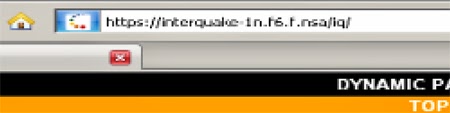
Web-browser with NSANet address for the INTERQUAKE tool, used by NSA's
Special Collection Service (SCS, organizational code: F6) units
(Click for the full presentation)


Besides NSANet as its general purpose intranet, NSA also operates several other computer networks, for example for hacking operations conducted by the TAO-division. We can see some of these networks in the following diagram, which shows how data go (counter-clockwise) from a bot in a victim's computer on the internet, through a network codenamed WAITAUTO to TAONet and from there through a TAONet/NSANet DeMilitarized Zone (DMZ) to data repositories and analysing tools on NSANet:


Diagram showing the data flow for TAO botnet hacking operations
(Source: NSA presentation - Click to enlarge)


PEGASUS
- Until 2010: GRIFFIN (Globally Reaching Interconnected Fully Functional Information Network)
- Classification level: SECRET//REL FVEY
- Access: US, UK, CAN, AUS, NZL military users
- Controlled by: DIA(?)
- Purpose: Information sharing and supporting command and control systems
- Applications: Secure e-mail, chat and VoSIP communications


STONEGHOST (Quad-Link or Q-Lat)
- Classification level: TOP SECRET//SCI
- Access: US, UK, CAN, AUS, NZL(?) military intelligence users
- Controlled by: DIA
- Purpose: Sharing of military intelligence information
- Applications: Intelink-C, etc.


CFBLNet (Combined Federated Battle Laboratories Network)
- Classification level: Unclassified and SECRET
- Access: US, UK, CAN, AUS, NZL, and at least nine European countries Research & Development institutions
- Controlled by: MultiNational Information Sharing (MNIS) Program Management Office
- Purpose: Supporting research, development and testing on command, control, communication, computer, intelligence, surveillance and reconnaissance (C4ISR) systems.
- Applications: Communications, analytic tools, and other applications


The CFBLNet countries in 2009, with three of the Five Eyes countries (yellow line),
six European NATO countries and the NATO organization (black line),
six NATO guest nations (dotted line) and two non-NATO countries.
(source: NATO Education and Training Network (pdf), 2012)


For communications among the members of multinational coalitions, the United States provides computer networks called Combined Enterprise Regional Information eXchange System (CENTRIXS). These are secure wide area network (WAN) architectures which are established according to the specific demands of a particular coalition exercise or operation.

CENTRIXS enables the secure sharing of intelligence and operational information at the level of "SECRET REL TO [country/coalition designator]" and also provides selected centralized services, like Active Directory/DNS Roots, VoIP telephony, Windows Server Update Services (WSUS) and Anti-Virus Definitions.

There are more than 40 CENTRIXS networks and communities of interest (COIs) in which the 28 NATO members and some 80 other countries participate. The best-known CENTRIXS networks are:


CENTRIXS Four Eyes (CFE or X-Net)
- Classification level: TOP SECRET//ACGU
- Address format: http://subdomains.domain.xnet.mnf
- Access: US, UK, CAN, AUS military users
- Controlled by: DIA
- Purpose: Operational coordination through sharing and exchange of intelligence products
- Applications: Various services


CENTRIXS-ISAF (CX-I)
- Classification level: TOP SECRET//ISAF
- Access: ca. 50 coalition partners
- Controlled by: ?
- Purpose: Sharing critical battlefield information; US component of the Afghan Mission Network (AMN).
- Computer applications: Web services, instant messaging, Common Operational Picture (COP), etc.
- Voice over IP


CENTRIXS-M (Maritime)
- Classification level: TOP SECRET ?
- Purpose: Supporting multinational information exchange among the ships of coalition partners of the US Navy to provide access to critical, time-sensitive planning and support data necessary to carry out the mission
- Computer applications: E-mail, Chat messaging, Webpages, etc.


Report from the Afghanistan Regional Command Southwest (RC(SW))
with a SIPRNet and a CENTRIXS e-mail address and webpage
(Full document in pdf format - Click to enlarge)


Some other CENTRIXS networks are:

CENTRIXS-GCTF
- Address format: http://subdomains.domain.gctf.cmil.mil
- For the ca. 80 Troop Contributing Nations of the Global Counter-Terrorism Force (GCTF)

CENTRIXS-CMFC
- For the Combined Maritime Forces, Central Command (CMFC)

CENTRIXS-CMFP
- For the Combined Maritime Forces, Pacific (CMFP)

CENTRIXS-J
- For the United States and Japan

CENTRIXS-K
- For the United States and South-Korea


Links and Sources
- KMI Media Group: Everything Over Internet Protocol (2009)
- US National Intelligence: A Consumer's Guide (pdf) (2009)
- Paper about How to Use FASTLANEs to Protect IP Networks (pdf) (2006)