Wednesday, November 27, 2013

DRTBOX and the DRT surveillance systems

(Updated: May 6, 2015)

In recently published screenshots from NSA's BOUNDLESSINFORMANT tool about France, Spain, Norway and Afghanistan we see the mysterious term DRTBOX. For example, the screenshot for Norway presents 33 million telephony metadata, which were collected from mobile phone networks by a facility designated US-987F and processed/analysed by DRTBOX:


(Click for a bigger version)


Unlike what it seems, DRTBOX is not a codename, but part of a wireless surveillance system, made by a company generally known as DRT. This article will show that this company manufactures a range of sophisticated surveillance and tracking devices, used by US law enforcement and signals intelligence agencies.


Digital Receiver Technology, Inc.

DRT is the abbreviation of Digital Receiver Technology, Inc. This company was formerly known as Utica Systems, Inc. and founded in 1980 in Frederick, Maryland, to produce devices for what was called the "Communications Surveillance Community". The company developed a solid reputation for communication equipment based on Digital Signal Processing (DSP).

In October 1997, the company adopted its current name and moved to a new plant in Germantown in April 1998. DRT was purchased by Boeing in December 2008 and is now a wholly-owned subsidiary of this major US military contractor. DRT continued its production of state-of-the-art DSP-based equipment and was described as a "key supplier in the growing SIGINT market" in 2009.

In 2010, Boeing also acquired Argon ST and combined with DRT this created a "SIGINT powerhouse", giving Boeing a competitive advantage in the SIGINT market, according to market analysts. In 2011, both acquisitions were consolidated into the new Electronic & Mission Systems (E&MS) division of the Boeing company.

In fall 2012, DRT moved to a new facility in the Milestone area of Germantown. This facility comprises 135,000 sq. ft. with approximately 50,000 sq. ft. dedicated to equipment manufacture, and the remainder dedicated to offices and engineering development laboratories:


The headquarters of Digital Receiver Technology, Inc. in Germantown, MD.
(photo: www.drti.com)


Currently, the company's homepage only advertises miniature multi-format wireless communications scanners to be used by the wireless industry for measurement and testing purposes. As an example, the website shows two products from the 4300-series.

But: "Due to the sensitive nature of our work, we are unable to publicly advertise many of our products". This is followed by contact information for commercial customers and for "all other" customers, which are obviously government agencies. Latter can contact DRT through a mail address and also by calling toll free: "(866) DIRTBOX" - a clear hint to the DRTBOX mentioned in the NSA screenshots.

Just like many other military contractors in recent years, DRT also removed information about national security related products from its website. Between 2003 to 2009, earlier versions of DRT's homepage frankly said:
"DRT designs and manufactures advanced electronic equipment to support the missions of the US Signals Intelligence (SIGINT) and law enforcement communities. The current product line includes a variety of portable and rack-mounted wireless communications receivers capable of processing a variety of modern wireless protocols. For more information about these products, please contact DRT."


Law enforcement

A good example of the devices which DRT manufatures and develops for use by law enforcement agencies is given by the company itself, in trying to open new markets.

In 2010, Boeing, on behalf of its subsidiary DRT, submitted a statement (pdf) before the National Telecommunications and Information Administration (NTIA) in reaction to an inquiry regarding contraband cell phone use in prisons. The statement says that:
"DRT has developed a device that emulates a cellular base station to attract cell phones for a registration process even when they are not in use. During this registration process calls are not disrupted. All calls, including 911 calls, are released, including those made from the contraband cell phones. The DRT device identifies cell phones as “not of interest” or “of interest” (i.e., the contraband cell phones).

Cell phones not of interest, such as those belonging to prison personnel or commercial users in the area, are returned to their local network. Cell phones of interest are forced to transmit so that the DRT device can locate them by calculating a line of bearing.

In one mode of operation, the DRT device then returns the cell phone to its network, permitting it to send and receive calls. In another mode of operation designed for use by federal law enforcement entities, the cell phone can be locked onto the DRT device, preventing its contraband use."

Boeing wanted NTIA to recommend to Congress that the Communications Act of 1934 should be modified in order to allow prison officials and state and local law enforcement to use these kinds of cell phone management, prevention or location technologies. Currently, only federal agencies, like the FBI, are allowed to use devices that jam or block wireless communications. Federal Communications Commission (FCC) licensing should also apply, for which Boeing delivered a similar statement in 2012.


A similar device (also known as IMSI Catcher, Cell-site Simulator or Digital Analyzer) used by American law enforcement agencies for tracking and intercepting cell phones is called StingRay, which is manufactured by the Harris Corp. The price of a StingRay device is between 60.000,- and 175.000,- USD. Harris also provides related equipment under the nicknames AmberJack, KingFish, TriggerFish and LoggerHead.


Prison pilots

In December 2010, DRT participated in a pilot at the Maryland Correctional Institution-Jessup (MCIJ). After sensors were placed, DRT collected data showing when cell phones were turned off, turned on and registered with the nearest cell phone tower. Data were send to a laptop used to record the data and the company then analyzed the time and length of messages over the course of the pilot. A portable sensor was used to identify particular cells that had a high probability of cell phone usage within.

In 2012, DRT was selected to develop and implement a Managed Access System (MAS) for the California State Prison system. A MAS is used to allow authorized cell phones to connect to the standard carrier networks, while preventing unauthorized cell phones (like from inmates) from connecting to the carrier networks.


Other usage

The aforementioned Boeing statement claimed that DRT's cell phone management, prevention and location technologies could also provide important benefits in a wide variety of law enforcement situations outside the prison context. For example, Special Weapons and Tactics (SWAT) teams and other paramilitary tactical units could effectively control wireless communications by suspects in a building during a raid.

Boeing carefully described only those future applications for which regulations have to be changed - trying not to admit that DRT systems are already used at the federal level for decades. They provide agencies like FBI with some powerful tools (DRT devices can be used to perform a man-in-the-middle attack), although they are expensive and must be operated by highly trained law enforcement personnel.

At the FBI, the DRT systems are likely operated by the Data Intercept Technology Unit (DITU), which is a highly secretive division specialised in intercept technology. DITU is also responsible for collecting data from US internet companies under NSA's PRISM program. For these federal agencies, a presentation about DRT devices was given at the 10th FED TECH Interagency Technical Training Conference, held in San Diego in January 2010:


In this schedule we see "DRT Box" again, but apart from a LinkedIn-profile, this term is rarely found and therefore it's not really clear what it stands for. At first glance it seems that DRTBox simply refers to box-like surveillance devices, but if we look at the BOUNDLESSINFORMANT screenshots, we see that the actual data collection is done by facilities designated by SIGADs and that DRTBOX is in the same section as for example XKEYSCORE, which means DRTBOX is probably an integrated indexing and analysing system for wireless communications data, just like XKEYSCORE is for internet data.


Signals Intelligence

Where the FBI uses systems from Digital Receiver Technology domestically, the NSA is most likely the main customer for use abroad. On a website for Signals Intelligence (SIGINT) and Electronic Warfare (EW), DRT is listed as a provider of:
- SIGINT Design Engineering Services
- SIGINT Consulting Services
- Communications ESM Systems
- COMINT Systems
- RF Receivers

DRT products for signals intelligence missions include high performance Software Definable Receiver (SDR) and transceiver products, including multi-channel platforms for man-portable, mobile and airborne applications, aboard RC-135 Rivet Joint, Combat Sent or Cobra Ball aircraft.

From various public job descriptions it becomes clear that DRT devices are widely used in tactical ground operations, where they are part of the equipment used by SIGINT/EW collection teams assigned to field deployed Special Forces Groups. These are so-called Low Level Voice Intercept (LLVI) devices.

DRT systems are also used as remote controlled collection systems, with the surveillance devices installed at fixed locations, like in areas where there's widespread hostile cell phone or radio use. The collected data go to ONEROOF, which is NSA's main tactical SIGINT database, containing raw and unfiltered intercepts.


Low Level Voice Intercept equipment being used during a field operation.
It's not clear whether the device in the video is from DRT,
but it's certainly very similar.


DRT SIGINT products

A job description for a SIGINT Systems Engineer (job location: Fort Meade) requires "experience working with SIGINT systems, especially on systems utilizing Digital Receiver Technology (DRT) Series 1000 and 2000 equipment" and also familiarity "with the software used to control the DRT systems". Software used for the 1000 series product line is called Alaska.

More specific designations of DRT devices from the 1000-series can be found in various other job resumes, reading like "SIGINT/EW collection and exploitation systems, to include the DRT-1101A/1301B/1501, MINI-EXPIATION, HIDRAH, LOGGERHEAD, Harris Suite (STINGRAY, KINGFISH, BLACKFIN, GOSSAMER), AR-8200, Explorer/Scout, and the PRD-13v2/ISSMS".

The DRT 1101A was a second generation wireless communications receiver developed by DRT around the year 2000. DRT's former website described the device as follows:
"The DRT 1101A provides a compact, yet powerful, test and measurement capability for a variety of first and second generation wireless standards. The system also possesses the capability to detect and extract cellular FAX signals. The system is based on an industry-standard bus format, and uses the latest in digital signal processing (DSP) and microprocessor technology."

Another device from the 1000-series is the DRT 1301C, which is used by Special Operations Forces:
"The DRT 1301C, manufactured by Digital Receiver Technology, Inc., is a portable, ruggedized radio designed for operations in tactical and/or harsh environments. It provides a miniature yet powerful surveillance capability. The radio has a frequency range of 20-3000 MHz and operates against a variety of analog and digital wireless standards. The transmitter has a power output range of <1 W (standby) to 75 W (48 channels, 3 tuners); it weighs 10.5 lb and measures 3 in. (H) by 8.5 in. (W) by 11.2 in. (D)."

An example of a DRT device from the 2000-series is the DRT 2101A, which was described as:
"a compact wideband tuner system consisting of up to eight wideband tuner modules, each covering the 0.5 MHz to 3 GHz frequency band. Each tuner module has a 30-MHz instantaneous bandwidth and can be operated in either an independently or coherently tuned mode under software control. The tuner module is factory configured to provide a high-level analog baseband output."
The Internet Archive also contains this picture of the DRT 2101A device as it looked in 2003:


See also the description and the picture of DRT's Wireless Processor Module 2 (WPM2) in the Internet Archive.


The Military Intelligence School's System Training Plan (pdf) from October 2013 about the Prophet Electronic Support System says that DRT devices are used in the Prophet Sensor vehicles, which are the ground-based tactical SIGINT collection components of the Prophet system:
- A DRT 1201B receiver is in the Prophet Spiral 1 Sensor (military designation: AN/MLQ-40(V)4), which is a M1102 tactical trailer, pulled by a M1165 B3 three-seat, fully armored High-Mobility Multipurpose Wheeled Vehicle (HMMWV or Humvee). Two Panasonic Toughbooks CF29 or CF30, running mission and communications software packages, control the DRT 1201B and enable the reporting and processing of intelligence. An AN/VRC-99 line-of-site radio provides data access to NSANET.

- A second DRT 1301C receiver-processor for man-packable operations is in the Prophet Enhanced Sensor.

- A DRT 1201 receiver is in the fixed-site version of the Prophet Enhanced Sensor, which also contains a BAT-1214 SATCOM terminal and a DF90/DF80/MS Antenna, among other equipment.

- A DRT 1301C is in the Mobile-At-the-Halt configuration, along with a DF90 antenna, and BAT-750 SATCOM terminal. Here, the DRT 1301C can also be reused in a man-packed configuration.

- A DRT 1201C replaces the DRT 1201B in a fourth variant of the Prophet Enhanced Sensor in stationary fixed-site configuration. The DRT 1201C device is described as a next generation receiver-processor that increases collection capability and enables future upgrades.

(similar SIGINT equipment for the Prophet system is developed by the Linkabit division of L-3 Communications)


A Prophet Spiral M1165 Humvee


The tactical deployed DRT systems are mainly used for operations in Iraq and Afghanistan, but it's very well possible that the equipment was also used at the joint NSA-CIA Special Collection Service (SCS) unit in the US embassy in Berlin, which intercepted the mobile phone of German chancellor Merkel.

Update:
On May 5, 2015, the website The Intercept published a 2006 NSA presentation about the RT10 collection effort, which was part of the Real Time-Regional Gateway (RT-RG) for Iraq, and later also for Afghanistan. This presentation includes a slide which shows that DRT (like MATTERHORN and EXPIATION) is used for the tactical interception of wireless GSM traffic:


Diagram showing tactical and national interception efforts for GSM communications
In the bottom left corner DRT is mentioned as one of the tactical systems
(Click to enlarge)


Other usage

Of course not only American agencies are using this kind of interception equipment. The FBI reportedly removed from several cell phone towers in the Washington DC area transmitters that fed all data to wire rooms at foreign embassies.*

Update #1:
On November 13, 2014, the Wall Street Journal broke a story saying that since 2007, the Technical Operations Group of the US Marshals uses "dirtboxes" aboard Cessna aircraft operating from at least five metropolitan-area airports. The DRTBoxes mimic cell towers and trick cellphones to collect identity and location information on cell phone users, this in order to track and catch criminals like drug-traffickers.
The FBI is apparently using the similar Stingray devices only to collect phone metadata, not content, for which individual warrants would be required.
Update #2:
On December 13, 2014, it was reported that DRT-like cell phone interception devices were found near important government offices and buildings in the city center of the Norwegian capital Oslo. In March 2015, it came out that these devices were actually placed by the Norwegian police and the Police Security Service PST, without properly informing the country’s National Communications Authority.


Links
- Gizmodo.com: Here Is the Spy Equipment That Powers the FBI's Secret Dragnet
- Harvard Law review article: Your Secret Stingray's No Secret Anymore: The Vanishing Government Monopoly Over Cell Phone Surveillance and Its Impact on National Security and Consumer Privacy
- Heise.de: Solange keiner meckert - Wie IMSI-Catcher unauffällig legalisiert wurden
- Matt Blaze: How Law Enforcement Tracks Cellular Phones
- WaPo.com: New documents show how the NSA infers relationships based on mobile location data
- USAToday.com: NSA Phone Tracking
- Volkskrant.nl: De DRT2101A: het apparaat waarmee de NSA telefoons afluistert
- List of 217 part numbers from Digital Receiver Technology, Inc.
- Presentation about Digital receiver technology for RWR, ESM and ELINT applications (pdf)
- Washington Institute: Stabilizing Iraq: Intelligence Lessons for Afghanistan
- Journal of Electronic Defense: What's New in SIGINT software?
- Overview: Toward a Universal Radio Frequency System for Special Operations Forces (pdf)

Saturday, November 23, 2013

Screenshots from BOUNDLESSINFORMANT can be misleading


Over the last months, a number of European newspapers published screenshots from an NSA tool codenamed BOUNDLESSINFORMANT, which were said to show the number of data that NSA collected from those countries.

Most recently, a dispute about the numbers mentioned in a screenshot about Norway urged Snowden-journalist Glenn Greenwald to publish a similar screenshot about Afghanistan. But as this article will show, Greenwald's interpretation of the latter was wrong, which also raises new questions about how to make sense out of the screenshots about other countries.


Norway vs Afghanistan

On November 19, the website of the Norwegian tabloid Dagbladet published a BOUNDLESSINFORMANT screenshot which, according to the paper, showed that NSA apparently monitored 33 million Norwegian phone calls (although actually, the NSA tool only presents metadata).

The report by Dagbladet was almost immediatly corrected by the Norwegian military intelligence agency Etteretningstjenesten (or E-tjenesten), which said that they collected the data "to support Norwegian military operations in conflict areas abroad, or connected to the fight against terrorism, also abroad" and that "this was not data collection from Norway against Norway, but Norwegian data collection that is shared with the Americans".

Earlier, a very similar explanation was given about the data from France, Spain and Germany. They too were said to be collected by French, Spanish and German intelligence agencies outside their borders, like in war zones, and then shared with NSA. Director Alexander added that these data were from a system that contained phone records collected by the US and NATO countries "in defense of our countries and in support of military operations".

Glenn Greenwald strongly contradicted this explanation in an article written for Dagbladet on November 22. In trying to prove his argument, he also released a screenshot from BOUNDLESSINFORMANT about Afghanistan (shown down below) and explained it as follows:
"What it shows is that the NSA collects on average of 1.2-1.5 million calls per day from that country: a small subset of the total collected by the NSA for Spain (4 million/day) and Norway (1.2 million).

Clearly, the NSA counts the communications it collects from Afghanistan in the slide labeled «Afghanistan» — not the slides labeled «Spain» or «Norway». Moreover, it is impossible that the slide labeled «Spain» and the slide labeled «Norway» only show communications collected from Afghanistan because the total collected from Afghanistan is so much less than the total collected from Spain and Norway."


Global overview

But Greenwald apparently forgot some documents he released earlier:

Last September, the Indian paper The Hindu published three less known versions of the BOUNDLESSINFORMANT global overview page, showing the total amounts of data sorted in three different ways: Aggregate, DNI and DNR. Each results in a slightly different top 5 of countries, which is also reflected in the colors of the heat map.

In the overall (aggregated) counting, Afghanistan is in the second place, with a total amount of over 2 billion internet records (DNI) and almost 22 billion telephony records (DNR) counted:


The screenshot about Afghanistan published by Greenwald only shows information about some 35 million telephony (DNR) records, collected by a facility only known by its SIGAD US-962A5 and processed or analysed by DRTBox. This number is just a tiny fraction of the billions of data from both internet and telephone communications from Afghanistan as listed in the global overview.


Differences

With these big differences, it's clear that this screenshot about Afghanistan is not showing all data which NSA collected from that country, not even all telephony data. The most likely option is that it only shows metadata from telephone communications intercepted by the facility designated US-962A5.

That fits the fact that this SIGAD denotes a sub- or even sub-sub-facility of US-962, which means there are more locations under this collection program. Afghanistan is undoubtedly being monitored by numerous SIGINT collection stations and facilities (like US-3217, codenamed SHIFTINGSHADOW which targets the MTN Afghanistan and Roshan GSM telecommunication companies), so seeing only one SIGAD in this screenshot proves that it can never show the whole collection from that country.

This makes that Greenwald's argument against the data being collected abroad is not valid anymore (although there maybe other arguments against it). Glenn Greenwald was asked via Twitter to comment on the findings of this article, but there was no reaction.


More questions

The new insight about the Afghanistan data means that the interpretation of the screenshots about other countries can be wrong too. Especially those showing only one collection facility, like France, Spain and Norway (and maybe also Italy and The Netherlands), might not be showing information about that specific country, but maybe only about the specific intercept location.

This also leads to other questions, like: are this really screenshots (why is there no classification marking)? Are they part of other documents or did Snowden himself made them? And how did he make the selection: by country, by facility, or otherwise?

There are many questions about NSA capabilities and operations which Snowden cannot answer, but he can answer how exactly he got to these documents and what their proper context is. Maybe Glenn Greenwald also knows more about this, and if so, it's about time to tell that part of the story too.


> See also: The BOUNDLESSINFORMANT interface


Links and Sources
- Le Monde/BugBrother: La NSA n’espionne pas tant la France que ça
- Volkskrant.nl: Bespioneerde de NSA ons of hebben wij zelf afgeluisterd?
- MatthewAid.com: Greenwald’s Interpretation of BOUNDLESSINFORMANT NSA Documents Is Oftentimes Wrong
- Dagbladet.no: NSA-files repeatedly show collection of data «against countries» - not «from»
- WSJ.com: Europeans Shared Spy Data With U.S.
- Cryptome.org: Some thoughts and explanations about the BOUNDLESSINFORMANT numbers

Friday, November 15, 2013

Five Eyes, 9-Eyes and many more

(Updated: January 22, 2014)

On November 2, The Guardian published a lenghty article about the Snowden-leaks, which said that besides the close intelligence-sharing group of the US, Britain, Canada, Australia and New-Zealand, known as 5-Eyes, there are also groups called 9-Eyes and 14-Eyes.

According to The Guardian, the first consists of the 5-Eyes countries plus Denmark, France, the Netherlands and Norway and the latter adding another five European nations. This caused some embarrassment, as especially France and The Netherlands were heavily opposed to NSA's eavesdropping operations.

For almost everyone the existance of these 'Eyes' came as a surprise, but as this article will show, there are also 3-, 4-, 6-, 7-, 8-, 9- and 10-Eyes communities. They were created for restricting access to military and intelligence information to respective numbers of coalition nations. These 'Eyes' are used as handling instructions and often supported by dedicated communication networks.


Many new 'Eyes'

First we take a look at what The Guardian wrote about the 9-Eyes and other intelligence-sharing groups:
"The NSA operates in close co-operation with four other English-speaking countries - the UK, Canada, Australia and New Zealand - sharing raw intelligence, funding, technical systems and personnel. Their top level collective is known as the '5-Eyes'.

Beyond that, the NSA has other coalitions, although intelligence-sharing is more restricted for the additional partners: the 9-Eyes, which adds Denmark, France, the Netherlands and Norway; the 14-Eyes, including Germany, Belgium, Italy, Spain and Sweden; and 41-Eyes, adding in others in the allied coalition in Afghanistan."

In a similar article, The New York Times also mentioned these two new Eyes-groups, but without naming the participating countries, and instead of the 41-Eyes, adding NACSI, the NATO Advisory Committee for Special Intelligence:
"More limited cooperation occurs with many more countries, including formal arrangements called Nine Eyes and 14 Eyes and Nacsi, an alliance of the agencies of 26 NATO countries".

These new revelations seem to be confirmed by what is said in an informative 2012 paper (pdf) about Canada and the Five Eyes Intelligence Community:
"The Five Eyes sigint community also plays a ‘core’ role in a larger galaxy of sigint organizations found in established democratic states, both west and east. Five Eyes ‘plus’ gatherings in the west include Canada’s NATO allies and important non-NATO partners such as Sweden. To the east, a Pacific version of the Five Eyes ‘plus’ grouping includes, among others, Singapore and South Korea. Such extensions add ‘reach’ and ‘layering’ to Five Eyes sigint capabilities."

This text suggests that there are several western Five Eyes 'plus' groups, one of which sounds like the 14-Eyes mentioned by The Guardian. The eastern Five Eyes 'plus' refers to the 10-Eyes group, which will be described down below.

The existance of these hitherto unknown Eyes-groups came as a surprise, because it was generally assumed that NSA only had two kinds of partners for sharing signals intelligence:

- 2nd Party: the Five Eyes based upon the UKUSA-Agreement of 1946
- 3rd Party: a range of countries that have bilateral agreements with NSA


The CFBL Network

The term 9-Eyes could already be found in some other sources. One is an extensive article by the French weblog Zone d'Intérêt about the NATO exercise Empire Challenge 2008 (EC08), in which a number of operational and testing networks were used. One of them is the Combined Federated Battle Laboratories Network (CFBLNet), which is for research, development and testing on command, control, communication, computer, intelligence, surveillance and reconnaissance (C4ISR) systems.

The CFBL network consists of an unclassified (black) backbone network (the Blackbone) with transporting the encrypted traffic of several classified and unclassified enclaves as its main purpose. The main secure domains on the CFBL Blackbone are:
- The CFBLNet Unclassified Enclave (CUE), which is unclassified, but traffic is secured using 128 bit Advanced Encryption Standard (AES) encryption.

- The Four-Eyes Enclave (FEE), which is a classified enclave at the SECRET level, accessible for USA, GBR, CAN and AUS only. This enclave was moved from behind the BLUE enclave to the Blackbone in 2006.

- The 6-Eyes or BLUE Enclave, which is a classified enclave at the SECRET level, accessible for the Five Eyes plus NATO (see paragraph about 6, 8 and 10-Eyes)

- The 9-Eyes or NATO RED Enclave, which is also a classified enclave at the SECRET level, accessible for the NATO members of the Five Eyes plus France, Germany, Italy, Spain, The Netherlands and Norway. This enclave was established in 2006 for classified initiatives among NATO members.

- The Initiative Enclaves, which are created temporarily to support specific initiatives and are classified according to the initiative requirements.

We can see these parts of the CFBL Network mentioned in this slide about the networks used in the EC08 exercise:


The various networks involved in Empire Challenge 2008 (EC08)
(COI = Community of Interest, CFE = CENTRIXS Four Eyes,
DDTE = Distributed Development and Test Enterprise)
(full presentation: EC08 Networks (pdf), May 2008)


The 9-Eyes countries are also listed in a table in a NATO standardization document (pdf) from 2010. There we see that from the 4-Eyes only the US, the UK and Canada are part of the 9-Eyes, which makes sense, as Australia is not a NATO partner:


This table lists the groups of nations to which some specific multi-national intelligence and reconnaissance information can be released. This is shown by using the dissemination markings or handling instructions: REL NATO, REL 4-EYES, REL 9-EYES.

The famous Five Eyes term also has its origins in the former NSA dissemination marking EYES ONLY, which defined which 'eyes' may see certain material. Accordingly, documents authorized for release to the five UKUSA-countries were initially marked as AUS/CAN/NZ/UK/US EYES ONLY.

In conversations, allied intelligence personnel adopted the term "Five Eyes" as a shorthand because it was much easier to say. This term became widely used and even got its own abbreviation: FVEY, which is now used in REL FVEY, after the EYES ONLY marking was being replaced by the REL TO [country/coalition designator] format.


A classification line showing the REL FVEY marking


Two different 9-Eyes?

If we compare the nine members of the CFBLNet NATO domain with the 9-Eyes countries mentioned in The Guardian article, we see some differences:

CFBLNet/NATO:
USA, GBR, CAN, FRA, DEU, ITA, NLD, NOR, ESP

The Guardian:
USA, GBR, CAN, AUS, NZL, FRA, DNK, NLD, NOR

From the European NATO countries, France, The Netherlands and Norway are in both lists. The Guardian adds Denmark and the non-NATO members of the Five Eyes, which leaves Germany, Italy and Spain out.

Especially Germany and Italy not being included in this apparently close alliance seems strange, as both countries participate in other coalition groups and are both considered to be 3rd party partners of NSA. Maybe this explains Germany being "a little grumpy at not being invited to join the 9-Eyes group" as The Guardian read in GCHQ documents.

Unfortunately, The Guardian failed to provide any context or even a time period for their 9-Eyes and 14-Eyes listings, which makes it quite difficult to find an explanation for the different membership countries of these groups.

At first sight it seems there are two different 9-Eyes groups: one apparently closely related to NSA, and another one as a sharing group in the CFBLNet environment. But as 9-Eyes is used as a handling instruction for classified information, it has to be perfectly clear to which group of countries information marked REL 9-EYES may be released. Therefore we have to assume there can be only one 9-Eyes group at a time.

The 9-Eyes NATO group of the CFBL network was first mentioned in 2008 and still comprised the same nations in 2012. In the meantime, Sweden also became a full member of CFBLNet, but not being a NATO member, it wasn't included in the 9-Eyes sharing group.


The CFBLNet countries in 2009, with three of the Five Eyes countries (yellow line),
six European NATO countries and the NATO organization (black line),
six NATO guest nations (dotted line) and two non-NATO countries.
(source: NATO Education and Training Network (pdf), 2012)


One option to explain the differences between the two 9-Eyes could be changing membership, with countries added or removed on an annual basis depending on their participation in the CFBLNet. But this also wouldn't fit with the Guardian's list, as Australia and New Zealand are no NATO-members and Denmark is not a fully participating member nation of the CFBL network.

Unless The Guardian misinterpreted the Snowden-documents, it seems quite unlikely that their 9-Eyes could be the same as the NATO 9-Eyes on the CFBL network, but it seems also unlikely that there are two groups called 9-Eyes at the same time. The best guess at this moment would be that the Guardian's 9-Eyes was a group that only existed somewhere before the NATO group was formed.

Update:
From remarks made on Twitter by a Dutch journalist who works on the Snowden-papers, it seems that the 9-Eyes is a group for exchanging military signals intelligence related to operations in Afghanistan.


There's also the Multinational Interoperability Council (MIC), which is a forum for identifying interoperability issues and articulating actions to enhance coalition operations. It started in 1999 as the Six Nation Council and now has seven members: the US, Canada, Australia, Britain, France, Germany and Italy. It might be this group which is called 7-Eyes.

Also interesting is Alliance Base, which was the cover name for a secret Counterterrorist Intelligence Center (CTIC) that existed between 2002 and 2009. It was based in Paris and was a cooperation between six countries: the US, Canada, Australia, Britain, France and Germany. There's no indication this group was designated by a number of 'Eyes'.


The 14-Eyes and 3rd and 4th party partners

Now let's take a look at the 14-Eyes community, which was revealed for the first time by The Guardian. Looking at the number and the participating countries, it comes very close to CFBLNet, which had 13 full members (12 nations + the NATO organization) since 2010. But there are also some differences again:

CFBLNet members:
USA, GBR, CAN, AUS, NZL, FRA, DEU, NLD, NOR, ESP, ITA, SWE

The Guardian:
USA, GBR, CAN, AUS, NZL, FRA, DEU, DNK, NLD, NOR, ESP, ITA, BEL, SWE

These lists are very similar, except that Denmark and Belgium, which are on the Guardian's list, are not a (full) member of CFBLNet. Maybe these two countries joined CFBLNet only very recently, and in that case the 14-Eyes could refer to this group. It does show though that these NATO countries (and Sweden) are cooperating in additional information-sharing initiatives.

The exact purpose of such a cooperation in the 14-Eyes group isn't clear. The New York Times only says that the nations comprising the 9-Eyes and 14-Eyes groups have formal arrangements with NSA, which is something that also makes a country a traditional 3rd party partner.

According to Snowden-documents, about 30 countries have this status, but so far only the names of Germany, France, Austria, Denmark, Belgium and Poland were published. Some other sources say that Norway, Italy, Greece, Turkey, Thailand, Malaysia, Singapore, Japan, South-Korea, Taiwan, Israel and South Africa are 3rd party partners too.

If we compare this to the 14-Eyes, we see that only France, Germany, Norway, Italy, Belgium and probably Spain are known 3rd party partners. Sweden, Denmark and The Netherlands are not, but it's assumed they had or have less formal arrangements for exchanging SIGINT and cryptologic information with NSA. This also applies to Finland and Taiwan, and therefore these countries are sometimes called 4th party partners.

It seems there are roughly three possibilities:

A. All countries of the 14-Eyes (and subsequently those of the 9-Eyes) are actually 3rd party partners, because of having formal arrangements with NSA. Which means Sweden, Denmark and The Netherlands must have acquired that position in recent years. Grouping them in two 'Eyes' would only make sense if that's for some specific initiatives.

B. Countries belonging to the 9-Eyes and 14-Eyes have a more close relationship with NSA and are therefore somewhere in between the 2nd party and the 3rd party nations. This is what both papers suggest, but it seems not very likely that relationships like these allow that much of (formal) refinement.

C. The 9-Eyes and 14-Eyes are groups created for specific goals and consist of the Five Eyes with some additional 3rd and 4th party nations, depending on whether their participation is needed for achieving those goals.

Update:
A newly disclosed document has shown that all countries of the 14-Eyes are 3rd Party partners of NSA and that the actual name of this group is SIGINT Seniors Europe (SSEUR). More about this: 14-Eyes are 3rd Party partner forming the SIGINT Seniors Europe

In 2010, France was apperently ready to join the Five Eyes, but at the last moment the Obama White House said no.


The CFBL Network

The Combined Federated Battle Laboratories Network (CFBL or CFBLNet) is a distributed Wide Area Network (WAN), which allows for the testing of new multinational information-sharing capabilities before they're transitioned to the actual operational networks which are used worldwide to support Combatant Command operations. CFBLNet enables the sharing and exchange of information on experimentation and interoperability testing.

Each member nation operates several "Battle Lab" sites which are hook into the CFBLNet backbone at a national Point-of-Presence (PoP). In 2012 there were 247 sites divided over 12 countries. The backbone traffic is secured with TCE621 (in Europe) and TACLANE E100 (or KG-175 in the US) network encryptors. The Multinational Information Sharing Program Management Office (MNIS PMO) maintains day-to-day control and coordination of the network.

Every year, also several other NATO countries participate or observe as guest nations in one or more CFBLNet initiatives at existing lab sites.

The CFBLNet grew out the network designed to support the US Joint Warfighter Interoperability Demonstrations (JWID), which used to build a support network for the period of the demonstrations and tear it down afterwards. In 1999, the JWID exercise used, for the first time, a permanent infrastructure that became what is now called the Combined Federated Battle Lab Network (CFBLNet), as established by the NATO Consultation, Command and Control Board (NC3B) in 2001.


The 6, 8 and 10 Eyes

Creating separate access groups for coalition operations, and describing them with a certain number of 'Eyes' can be traced back to the early years of this century. The first occasion seems to have been the Joint Warrior Interoperability Demonstration 2003 in which also non-traditional partner countries were added to the communications network used by the UKUSA and NATO coalition.

Information sharing between different groups of coalition partners required that separate domains had to be created within one network: in 2003, the 5-Eyes countries and the NATO organization comprised the 6-Eyes domain, while these six members plus four Pacific Rim nations (Japan, South Korea, Thailand and Singapore) comprised the 10-Eyes domain. Each domain had its own Type-2/3DES-encrypted Virtual Private Network (VPN) which ran over a network secured by classified Type-1 encryption algorithms.


Slide with an overview of the 6-Eyes and 10-Eyes network domains
(full presentation: Agile Coalition Environment (pdf), 2003)


The 2004 edition of the Joint Warfighter Interoperability Demonstration also involved South-Korea, officially known as the Republic of Korea (ROK). To this end, three separate domains within CFBLNet were created and organized into two classification levels named 6-Eyes and 8-Eyes. The 8-Eyes domain consisted of the 6-Eyes countries plus NATO and ROK. The ROK domain was cryptographically isolated from the rest of CFBLNet by using TACLANE encryptors with Type-1 algorithms.


The 5, 4 and 3 Eyes

The long-standing and close intelligence-sharing community of the Five Eyes was downsized on two occasions. First in 1985, when New Zealand refused US nuclear-armed or nuclear-powered ships to visit its ports. As a result, the island was cut out of most intelligence arrangements led by the US. Some SIGINT was still being shared, but New Zealand got no American HUMINT or military intelligence anymore, except for operations in which it's actually participating.

Things not to be shared with New Zealand, were 4-Eyes only now. Staying outside most of the allied military operations, New Zealand was also not connected to the CENTRIXS Four Eyes (CFE) network (also called X-Net), which was created in 2001 and is extensively used for operational coordination between the remaining four partners: Australia, Canada, Great Britain and the US. Sites on this network have addresses in the format www.website.xnet.mnf

For information sharing and exchange between these nations, there's also a separate network codenamed STONEGHOST, which is maintained by the US Defense Intelligence Agency (DIA). This network was previously called Intelink-C, which runs over it, and is now sometimes referred to as Q-Lat or Quad link. Information restricted to the 4-Eyes partners is marked with their respective country codes or the abbreviation thereof: ACGU.


A document showing the REL TO USA ACGU marking (source)


For collaborative planning at the strategic level there's another network called Pegasus (until 2010: GRIFFIN), which provides secure e-mail, chat and VoSIP communications for the 5-Eyes partners, as the military cooperation between the US and New Zealand was restored again in 2007. Probably by then, a separate network called CENTRIXS-NZ was set up, which connects the Four Eyes with New Zealand. Sharing intelligence information between the US and the Five Eyes is done through NSANet, which is a TS/SCI network controlled by NSA.

Another sub-group of the Five Eyes was formed when Canada didn't join the US in the 2003 war against Iraq. With New Zealand also not formally engaging, the 5-Eyes were now reduced to just 3-Eyes: the United States, Great Britain and Australia.
The relationship between these three countries became closer as both Britain and Australia were granted an upgrade of their intelligence access by president George W. Bush: both countries were granted (temporary and limited) access to America's classified SIPRNet for certain joint missions. This also reflects their bigger SIGINT collecting capabilities, compared to those of Canada and New Zealand.

> See for the latest: NSA's foreign partnerships


CENTRIXS networks

The main US-led multinational coalition networks are called CENTRIXS, which stands for Combined ENTerprise Regional Information eXchange System. It's a secure wide area network (WAN) architecture, which can be established according to the demands of a particular coalition exercise or operation. CENTRIXS supports intelligence and operations information sharing at the SECRET REL TO [country/coalition designator] level. Some notable CENTRIXS networks are:

- CENTRIXS Four Eyes (CFE) for the US, Britain, Canada and Australia.
- CENTRIXS-NZ for the Four Eyes plus New Zealand.
- CENTRIXS-JPN for the United States and Japan.
- CENTRIXS-K for the United States and South-Korea.
- CENTRIXS-PHI for the United States and the Philippines.
- CENTRIXS-CNFC for the Combined Naval Forces CENTCOM (VPN within GCTF).
- CENTRIXS-MCFI for the Multinational Coalition Forces Iraq.
- CENTRIXS-ISAF (CX-I) which is the US component of the Afghan Mission Network to share critical battlefield information among 50 coalition partners.
- CENTRIXS-GCTF (CX-G) for the Global Counter Terrorism Forces, which is the US coalition network in Afghanistan to share information among more than 80 Troop Contributing Nations.

The countries connected to CENTRIXS-ISAF can be recognized as the 41-Eyes of the allied coalition in Afghanistan mentioned by The Guardian. This group grew slowly and was called 43-Eyes in 2010, when the NATO exercise Empire Challenge 2010 (EC10) changed its "main participating security domain" to "an International Security Assistance Forces (ISAF) equivalent 43-Eyes domain".

Probably also because of the steadily increasing number of coalition partners, shareable information is not marked with REL [..] EYES anymore, but with REL ISAF and REL GCTF.


Slide showing the complexity of multi-national information sharing
(full presentation: MultiNational Information Sharing (pdf), 2011)


Conclusion

We have seen that designations consisting of a number of 'Eyes' are used as a dissemination marking or handling instruction showing among which group of countries specific military or intelligence information may be shared.

The Guardian and the New York Times listed various 'Eyes' and some other groups in a way that suggests a hierarchy of how close their relationship with NSA would be: first the Five Eyes community, followed by 9-Eyes, 14-Eyes, NACSI, and with the 41-Eyes Afghanistan coalition being the loosest kind of cooperation.

A scheme like this looks attractive, but is at least partially misleading. For sure the Five Eyes are cooperating in the closest way, but the other groups have different scopes. NACSI is more like an advisory working group of NATO than an alliance of signal intelligence agencies, and the 41/43-Eyes community is for sharing battlefield information between members of the Afghanistan coalition.

Regarding the 9-Eyes and 14-Eyes communities, it's now up to journalists who have access to the Snowden-documents to provide more detailed information about whether they really represent more close alliances with NSA, or whether they're just 'working groups' of selected 3rd and 4th party nations, like most of the other 'Eyes' communities.

Update #1:
A newly disclosed document has shown that all countries of the 14-Eyes are 3rd Party partners of NSA and that the actual name of this group is SIGINT Seniors Europe (SSEUR). More about this: 14-Eyes are 3rd Party partner forming the SIGINT Seniors Europe

Update #2:
From remarks made on Twitter by a Dutch journalist who works on the Snowden-papers, it seems that the 9-Eyes is a group for exchanging military signals intelligence related to operations in Afghanistan.


Summary of all known 'Eyes'

- 3-Eyes: USA, GBR, AUS (TEYE)
- 4-Eyes: USA, GBR, CAN, AUS (ACGU)
- 5-Eyes: USA, GBR, CAN, AUS, NZL (FVEY)
- 6-Eyes: USA, GBR, CAN, AUS, NZL, NATO
- 7-Eyes: USA, GBR, CAN, AUS, FRA, DEU, ITA (MIC?)
- 8-Eyes: USA, GBR, CAN, AUS, NZL, NATO, ?, South-Korea
- 9-Eyes: USA, GBR, CAN, FRA, DEU, ITA, NLD, NOR, ESP (CFBLNet)
- 9-Eyes: Five Eyes + FRA, DNK, NLD, NOR (Guardian)
- 10-Eyes: USA, GBR, CAN, AUS, NZL, NATO, Japan, South-Korea, Thailand, Singapore
- 14-Eyes: Five Eyes + FRA, DNK, NLD, NOR, DEU, ESP, ITA, BEL, SWE (SSEUR)
- 41-Eyes: ISAF-countries in ? (Guardian)
- 43-Eyes: ISAF-countries in 2010


Links and Sources
- DeCorrespondent.nl: Over Five Eyes en Third Parties - Met wie werkt de NSA samen (2013)
- Privacy International report: Eyes Wide Open (pdf)
- DailyDot.com: How the NSA ranks its international spying partners
- Disa.mil: Multinational Information Sharing (MNIS)
- Article in French about Empire Challenge 2008
- The 2004 listing of Country Code Trigraphs and Coalition Tetragraphs (pdf)
- About Canada and the Five Eyes Intelligence Community (pdf)
- Far-Reaching Scenario Reflects Changing World (2003)
- Article about CENTRIXS-Maritime: connecting the warfighter
- Combined Operations Wide Area Network (COWAN)/Combined Enterprise Regional Information Exchange System (CENTRIXS) (pdf)
- The 1999 DMS GENSER Message Security Classifications, Categories, and Marking Phrase Requirements (pdf)

Thursday, October 31, 2013

How NSA targeted chancellor Merkel's mobile phone

(Updated: June 13, 2015)

Last week, the German weekly Der Spiegel revealed that NSA intercepted the mobile phone of the German chancellor Angela Merkel. Although most details were not known yet, the fact itself caused a severe crisis in the relationship between the United States and Germany.

Meanwhile, the original NSA targeting record containing chancellor Merkel's phone number has been published. One of the entries refers to a document about the NSA's SYNAPSE data model, which was disclosed earlier and provides us with a context for the targeting record. Finally, an impression of how the interception could have been conducted is given by a picture of the SCS interception equipment, which is presumably located in the US embassy in Berlin.


The NSA targeting record

The NSA document mentioning Merkel's phone number was published in the print editions of several German newspapers, but the tabloid paper BILD made a scan for their website:


Acoording to Der Spiegel, this document apparently comes from an NSA database in which the agency records its targets. This could be a database codenamed OCTAVE, which is used for tasking telephony targets. According to still undisclosed NSA documents, OCTAVE was replaced by the Unified Targeting Tool (UTT) in 2011.* This record has the following entries:

- SelectorType: a selector is the intelligence term for a name or a number that identifies an espionage target. This line says the type of the selector is PUBLIC DIRECTORY NUM[ber]

- SynapseSelectorTypeID: this designator, SYN_0044, refers to the SYNAPSE Data Model (see below).

- SelectorValue: here's the actual phone number of Merkel. In the print edition of the magazine we can see this phone number written as +49173-XXXXXXX. The country code for Germany (+49) is followed by the prefix code for mobile phone numbers from Vodafone (0173). According to Der Spiegel this is the number of Merkel's cell phone which was provided by her political party and which is the one she uses most to communicate with party members, ministers and confidants, often by text message. It's is just an ordinary cell phone without any security features, and therefore an easy target for intelligence agencies like NSA. It means that her official secure mobile phone wasn't targeted nor compromised.

- Realm: according to Der Spiegel, this field determines the format.

- RealmName: the name of the format, in this case 'rawPhoneNumber'

- Subscriber: GE CHANCELLOR MERKEL. As Angela Merkel wasn't yet chancellor when the surveillance started in 2002, either this entry or the whole record must have been updated after she became chancellor in November 2005.
Update:
A bit strange is that the abbreviation for Germany which is used here, GE, should have been replaced by DE after 2004, when the NATO STANAG codes were replaced with the ISO 3166-1 alpha-2 codes.

- Ropi: stands for Responsible Office of Primary Interest, an NSA unit that selects which targets should be monitored. In this case it's S2C32, the European branch of the so-called Product Line for International Security Issues.

- NSRL: stands for National SIGINT Requirements List, which is a daily updated compendium of the tasks, and the priority of those tasks, given to the various Signals Intelligence collection units around the world. 2002-388* indicates that this target was set in 2002, when Angela Merkel was head of the Christian democratic party CDU. Then Bundeskanzler Gerhard Schröder refused to join the US in the war against Iraq, so the US government could have been interested in knowing the position of his main political opponent.

- Status: A, which stands for Active. Der Spiegel says this status was valid a few weeks before President Obama’s Berlin visit in June 2013.

- Topi: stands for Target Office of Primary Interest. According to an NSA document, TOPIs are part of the Analysis & Production division, but Der Spiegel says these are units which are doing the actual interception. In this case, the TOPI is designated F666E, where F6 stands for the joint NSA/CIA Special Collection Service (SCS), which performs eavesdropping actions from inside US embassies in foreign capitals. 66E might then be (a part of) the SCS unit based in the US embassy in Berlin.

- Zip: this Zip code, 166E, is a distribution code for the OCTAVE tasking database (see below).

- Country Name: left blank, apparently the country code below was sufficient.

- CountryCode: which is GE for Germany


An interesting question is how Edward Snowden obtained this database record. Is it part of an NSA document for internal education or presentation purposes, or did he made a copy from the database itself? And if so, are there (many) more of these tasking records in his collection?

A targeting record like this marks the starting point of NSA's collection process. Because of that we know nothing about the follow up, except for the involvement of SCS unit F666E. Therefore, we have no indication about what form of surveillance has taken place: were only metadata gathered or also conversations recorded and text messages stored? And was this continuously, or (given the presumably small number of German linguists) only when there was a more specific need for information ?


The SYNAPSE data model

As we have seen, the second entry of the targeting record refers to SYNAPSE, which is some kind of data model used by NSA to analyze connections of foreign intelligence targets. A slide from a powerpoint presentation about this model was published by the New York Times on September 29, 2013. Note that the title has a huge spelling error as it reads SYANPSE instead of SYNAPSE:


SYNAPSE slide as published in the print edition of the NY Times
(scan by Cryptome - click for a bigger version)


The slide shows a rather complex diagram of all elements involved in examining the communications of a target. We will go through this diagram from top to bottom:

First we see a target, like a person or an organization, mentioned as "agent". These agents are designated by a name and identified by a NIC, which could stand for something like National Identification Card. 'Paki' could be a database for these ID numbers. The agents (targets) themselves are registered in TKB, which stands for Target Knowledge Base.

Agents use various devices, identified by designators like an e-mail or an IP address, a phone number or an IMEI, IMSI, IMN, RHIN or FHIN number (not clear what the last three stand for). The designations of these devices and the connections between them are collected in MAINWAY, which is NSA's main database for bulk telephone metadata.

The designators of the devices used by an agent/target get a 'Subscriber ID' for the OCTAVE database and are listed in the OCTAVE Tasked List. They also get a 'ShareableName' for the Unified Targeting Tool (UTT) to be listed in the UTT Active List. The designators are also labeled with UTT categories and OCTAVE Zip Codes.

Bottom right we see the Responsible Office of Primary Interest (ROPI) which somehow seems to manage the designators, maybe because these are the offices where Tasking takes place, which means selecting the targets to be monitored. Device designators (like phone numbers) of which the communications have to be collected are called Selectors.

Finally, the designators are referenced in the SIGINT Product Reports (blue dot) and the Intelligence Community (IC) Product Reports (red dot) which are released by the various Target Offices of Primary Interest (TOPI). LEXHOUND could be a database for these reports.

As the diagram shows pictures of a personal computer, but OCTAVE and MAINWAY are for telephony data, it seems the whole process is meant for both internet and telephony data.

Update:
According to an internal NSA Wiki entry, a tool called Synapse Workbench is used for querying metadata under the Supplemental Procedures governing Communications Metadata Analysis (SPCMA).

Note that the SYNAPSE model has some resemblance with a tool that NSA provided to the Dutch military intelligence service to track communications of Somali pirates, as was revealed on March 8, 2014 by NRC Handelsblad.


The SCS interception equipment

Except for the targeting record, there is no information about how exactly NSA intercepted Merkel's phone, but there are some strong indications. In Berlin, Vodafone mostly uses microwave transmissions on its mobile network and intelligence agencies can intercepted these without much effort.

To show how this could have taken place, Der Spiegel published a slide from a presentation of the Special Collection Service (SCS) showing pictures of an SCS antenna system codenamed EINSTEIN and its corresponding control device codenamed CASTANET. This unit can apparently intercept cell phone signals while simultaneously locating people of interest.


In Berlin, the SCS unit operates from inside the US embassy, which is in a building next to the famous Brandenburger Tor. It was opened on July 4, 2008 - in the presence of chancellor Merkel. Before, the US embassy was in a 19th century building in the Neustädtischen Kirchstraße. The spying equipment of the SCS unit is likely to be on the roof of the building, in a structure with conceiled windows:


(photo: Christian Thiel/Der Spiegel)


According to investigative journalist Duncan Campbell, who revealed the existence of the ECHELON system, these windows are covered by special dielectric (insulating) panels, that allow radio waves to pass through and be intercepted, while blocking visible light and concealing the interception equipment behind it.

This equipment usually consists of antenna, dishes or arrays which can collect every type of wireless communications on all available wavelengths. On the opposite side of the embassy's rooftop stucture there's a similar conceiled window right at the corner. With these corner windows on both sides, SCS can catch signals from all directions:


(photo through Dailyphotostream.blogspot.com)


On German television, the US embassador to Germany said that on the embassy's roof there's rather ordinary communications equipment, to stay in touch with Washington and other US embassies around the world. The embassy wouldn't let reporters and politicians in to take a look inside the rooftop structure, probably also because only people with the proper security clearance are allowed to enter these areas.

Because the targeting record clearly mentions unit F666E, it's most likely that chancellor Merkel's cell phone was intercepted by SCS from inside the US embassy. But as her phone uses the Vodafone network, it's also possible that NSA has some kind of backdoor access to this cellular network. Vodafone is a British company and at least NSA's British counterpart GCHQ has an arrangement with this company for tapping undersea fiber optic cables.

It is supposed that data gathered by the various SCS embassy units are send to the SCS headquarters at the joint CIA/NSA facility in College Park, Maryland, through an SCS communications hub, which is at the US Air Force base in Croughton, Northamptonshire, England.

Infrared images taken by the German television station ARD showed that behind the windows there was heat producing (electronic) equipment. But shortly after the eavesdropping came out publicly, the heat signature dropped dramatically. This seems to indicate that the spying facility has been shut down for the time being.


Ending the interception

Apparently, NSA started bugging chancellor Merkel upon intelligence requests from the State Department, according to two anonymous US government officials. The phone number of Angela Merkel was finally removed from the NSA's target list this Summer. According to the Wall Street Journal there was an internal government review which turned up that the agency was monitoring some 35 world leaders.

After learning this, the White House ordered to cut of some of these programs, including the one tracking the German chancellor and some other world leaders. Obama also ordered NSA to stop eavesdropping operations against the headquarters of the United Nations, the International Monetary Fund and the World Bank.


Update:
On June 12, 2015, the highest German public prosecutor, Harald Range, said the investigation into the eavesdropping on chancellor Merkel was closed, and no court case would be filed. This because there was no sufficient hard evidence: no original documents were provided, and also Edward Snowden seemed not to have any personal insights in this matter.


President Obama talks with chancellor Merkel using his telephone
for secure communications, August 29, 2013
(White House Photo by Pete Souza)


Links and Sources
- DuncanCampbell.org: The embassy spy centre network (updated)
- NYTimes.com: Tap on Merkel Provides Peek at Vast Spy Net
- DuncanCampbell.org: How embassy eavesdropping works
- TheWeek.com: Did the NSA mislead the President and Congress about foreign leader spying?
- FAZ.net: Es war Merkels Parteihandy
- Spiegel.de: How NSA Spied on Merkel Cell Phone from Berlin Embassy

Friday, October 25, 2013

How secure is the Merkel-Phone?

(Updated: March 30, 2015)

In an article by the German magazine Der Spiegel it was said that the NSA probably also eavesdropped on the mobile phone of chancellor Angela Merkel, which is dubbed Merkel-Phone in popular media. Der Spiegel provided little detail, but according to an article in Die Welt, the old cell phone number of Merkel was mentioned in a document provided by Edward Snowden.

Der Spiegel presented their evidence to the German government, which led to an investigation by German intelligence and security agencies. Apparently the material proved to be trustworthy and chancellor Merkel expressed her anger in the media and even in a phone call to president Obama.

Here we will take a closer look at how the official mobile phone of chancellor Merkel has been secured.

UPDATE #1:
A new article by Der Spiegel says that a phone number of chancellor Merkel was on an NSA target list since 2002. The document doesn't say what kind of communications were monitored or whether actual content had been recorded.


German chancellor Angela Merkel using
her former Nokia 6260 Slide phone
(photo: dapd, March 1, 2011)


If NSA targeted Merkel's old cell phone number, it's likely the one that belonged to her former smart phone, a Nokia 6260 Slide. This phone was used heavily by Merkel from October 2009 until July 2013. Voice communications through this device were secured by a system called SecuVOICE, made by the small Düsseldorf based company Secusmart GmbH, which was founded in 2007.

Initially, the solution provided by Secusmart could only encrypt voice, not text messages (SMS) or e-mail. For encrypting text messages Secusmart introduced a separate solution called SecuSMS in 2010, which means that between October 2009 and the implementation of SecuSMS, it was rather easy for NSA to at least intercept the text messages from Merkel's official phone (maybe in the same way they collected text messages of the Mexican president).

Another easy option could have been the monitoring and/or intercepting of the non-secure mobile phone that chancellor Merkel uses, which was provided by her political party (so no government money is used for party politics) and which she apparently also uses for her private conversations. For convenience, many politicians often use their private cell phones for government business too.

UPDATE #2:
On October 27, the German tabloid paper BILD revealed that according to anonymous intelligence officials, it was president Obama who ordered the monitoring of chancellor Merkel's communication and that NSA was apparently able to intercept her newest secure mobile phone (see below). Only the secure landline telephone in her office wasn't intercepted.

UPDATE #3:
In an unusual rapid and specific response, NSA said that director Alexander "did not discuss with President Obama in 2010 an alleged foreign intelligence operation involving German Chancellor Merkel, nor has he ever discussed alleged operations involving Chancellor Merkel. News reports claiming otherwise are not true".

UPDATE #4:
Already on October 24, the German paper FAZ learned that the Snowden-document seen by Der Spiegel mentioned the number of the cell phone provided to chancellor Merkel by her political party, which has no security features. There's no evidence that NSA targeted or even broke the encrypted communications from her secure mobile phone.


SecuSUITE @ BlackBerry 10

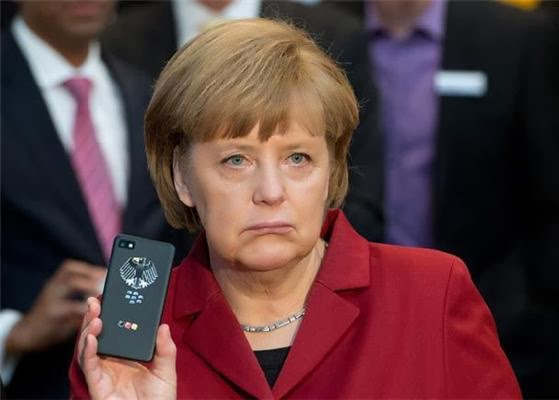
Since last July, chancellor Merkel uses the new BlackBerry Z10, which is equipped with the SecuSUITE system, consisting of SecuVOICE for encrypting voice, SecuSMS for encrypting text messages and some other applications for securing e-mail and sensitive data stored in the phone (SecuVOICE should not be confused with SecurVoice, the software which was used to secure Obama's Blackberry in 2009).


German chancellor Angela Merkel at the CeBIT 2013, showing
the BlackBerry Z10 with Secusmart encryption chip
(photo: Bundesregierung/Bergmann, March 4, 2013)


A new feature, which is standard available for this phone, is BlackBerry Balance. This enables users to keep both personal data and office work data securely separated in different partitions. In the personal section one can freely use social media and downloaded apps. These are separated from the business section, which can be automatically configured with business applications and e-mail through the Blackberry Enterprise Service 10 server. Users can easily switch from the personal to the business profile by entering a password. Stored user data are protected via 256-bit AES encryption.

For secure communications, the SecuSUITE application is added by inserting a Micro-SD card, called the Secusmart Security Card, in the memory card slot of the phone. This card contains a tamper-proof SmartMX P5CT072 crypto-controller made by NXP, with a PKI-coprocessor for performing the user authentication and a high speed coprocessor for encrypting voice and other data using the 128-bit AES algorithm. These encryption keys are transmitted using the Elliptic Curve Diffie Hellman (ECDH) protocol.
Update:
The microSD card used for SecuVOICE was specially developed for Secusmart by Giesecke & Devrient Secure Flash Solutions (G&D SFS), which is a joint venture of G&D and Phison Electronics Corporation. G&D is a major German manufacturer of SIM cards and related security products. Also contained on the micro-SD card is a 4GB flash memory, which allows users to store their data, like MS messages, contacts and calendar entries, in an encrypted format.

The BlackBerry Z10 with SecuSUITE application has been approved by the German government for use at the classification level Restricted (in German: Verschlussache - Nur für den Dienstgebrauch, abbreviated: VS-NfD). It's somewhat surprising that this is the lowest level, which might be explained by the fact that communications are encrypted using only 128-bit keys. Nowadays, it's generally advised to use keys with 256-bit length. Another reason is that a commercial available smart phone device is used, which is less secure than a custom made one.

For conversations at a higher classification level, German government and military officials are bound to dedicated landline phones, and conversations classified as Top Secret (German: Streng Geheim) may only take place from inside rooms that are secured against eavesdropping. Such high level voice and data communications are encrypted through the Elcrodat 6-2 system.

Nonetheless, the German federal government ordered 5000 secured BlackBerry devices, costing around 2500,- euro a piece. The new BlackBerry 10 with SecuSUITE was first presented by Secusmart at the IT business event and conference CeBIT 2013 in March:


The SecuVOICE solution is also available in the Netherlands, where it is (or was?) sold by Fox-IT and approved by the government for encrypting phone calls at the classification level Restricted (in Dutch: Departementaal Vertrouwelijk). NATO also approved SecuVOICE for usage at the level of Restricted.

Update:
In November 2014, the German government approved Blackberry's plan to take over Secusmart, which would mean the German crypto company wil become part of the canadian smartphone manufacturer. The German government examined whether this might pose a threat to its national security interests. Germany insisted that its Federal Office for Information Security (BSI) be granted certain access and control rights related to the code used in the Blackberry operating system.


SiMKo3 @ Samsung Galaxy

The secured BlackBerry 10 is not the only secure mobile smartphone approved for German government use.

There's also the SiMKo3 (the abbreviation of the German Sichere Mobile Kommunikation, Generation 3) solution from Deutsche Telekom, which comes with the Samsung Galaxy S III smart phone devices. Presently, this application is only approved for data communications at the Restricted level, but priced at 1700,- euro a piece, these phones are less costly than the BlackBerrys.

The SiMKo3 technique is similar to that of GD Protected, a system developed by General Dynamics to secure Samsung Galaxy S IV and LG Optimus smart phones so they can be used by high level government officials in the United States.


Links and Sources
- BILD.de: Obama wollte alles über Merkel wissen
- Spiegel.de: NSA-Überwachung: Merkels Handy steht seit 2002 auf US-Abhörliste
- T-Online.de: Mit welchem Handy hat die Kanzlerin telefoniert?
- Welt.de: Merkels Handy-Nummer in Snowdens Dokumenten
- WiWo.de: Sicherheitshandys: Blackberry sticht Telekom aus
- Heise.de: Technische Details zum Merkel-Phone 2.0
- ComputerWoche.de: Das können die neuen „Merkel-Phones“